Hearing Aid Specialist
How to Become a Hearing Aid Specialist in 2026
Learn how to become a Hearing Aid Specialist, including training pathways, state licensing, exams, education requirements, salary and current job opportunities.
How to Become a Hearing Aid Specialist in 2026
A career as a Hearing Aid Specialist can offer a relatively direct path into hearing healthcare compared with professions that require a doctoral degree. However, the exact requirements depend heavily on the state where you plan to work.
The International Hearing Society identifies two primary entry pathways: on-the-job training or an academic program in hearing instrument sciences. IHS also recommends contacting the licensing agency in your state before beginning training because requirements differ by jurisdiction. IHS
The U.S. Bureau of Labor Statistics classifies Hearing Aid Specialists under occupation code 29-2092. BLS lists a high school diploma or equivalent as the typical entry-level education nationally, along with moderate-term on-the-job training. Individual state licensing rules may impose additional requirements. Bureau of Labor Statistics
What does a Hearing Aid Specialist do?
According to ONET, Hearing Aid Specialists may select and fit hearing aids, administer and interpret hearing tests within their permitted scope, evaluate hearing-instrument performance, take ear impressions and help clients use hearing devices. ONET lists job titles such as Hearing Aid Specialist, Hearing Instrument Specialist, Hearing Instrument Dispenser and Licensed Hearing Instrument Specialist within this occupational family. O*NET OnLine
The exact activities a professional is legally permitted to perform are determined by state law and the person's license.
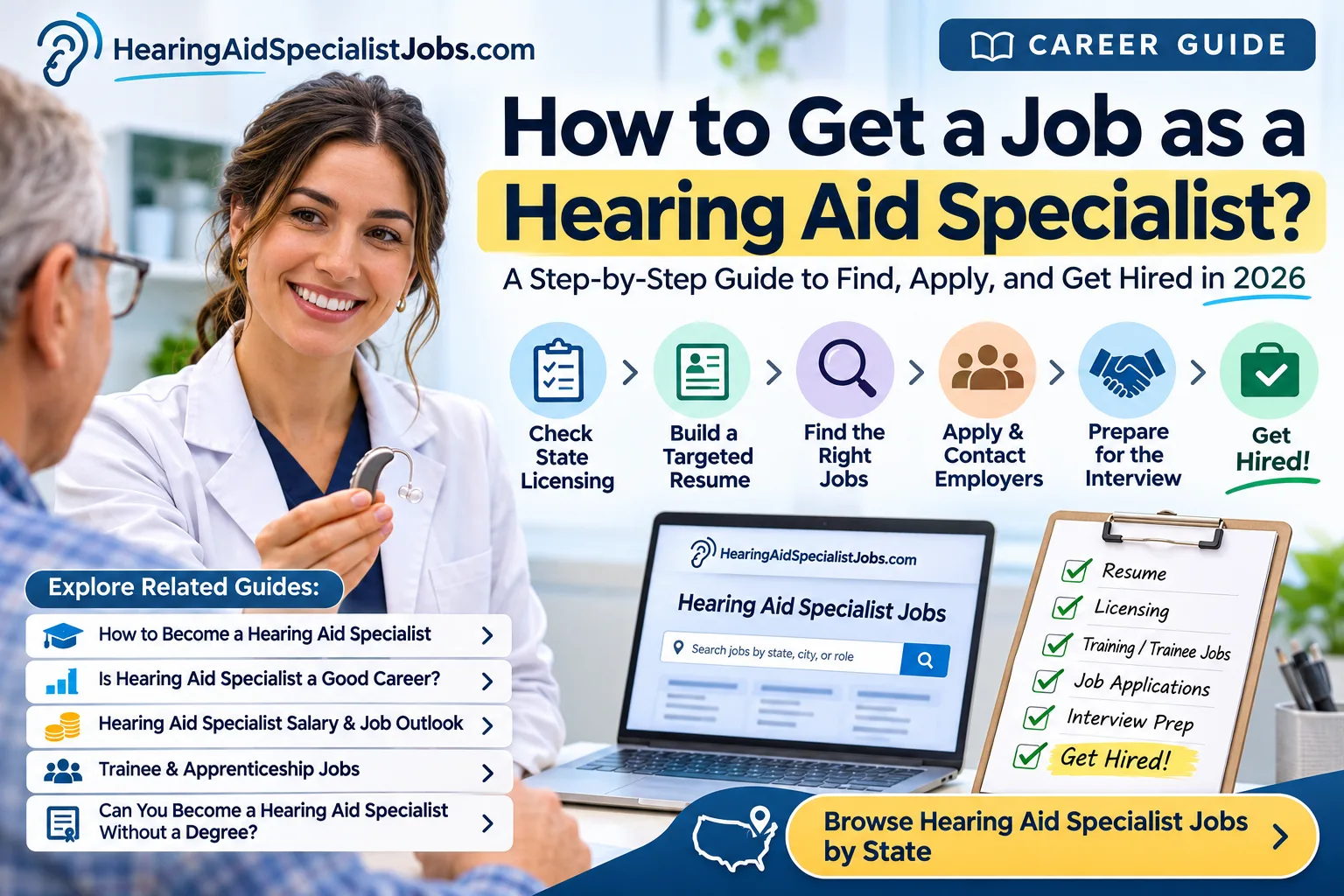
Step 1: Check your state's licensing requirements
This should be your first step.
There is no single national licensing process that replaces state requirements. IHS advises prospective specialists to contact the licensing agency for the jurisdiction where they intend to practice before choosing a training pathway. IHS
Requirements may address subjects such as:
minimum education
supervised training
apprenticeship requirements
written examinations
practical examinations
application fees
continuing education
license renewal
Because rules can change, applicants should rely on the relevant state licensing authority rather than a third-party summary alone.
Step 2: Choose a training pathway
IHS describes two general routes into the occupation.
On-the-job training
IHS says most people entering the profession do so through workplace training with a trainer or mentor. Candidates may find trainee or apprenticeship opportunities through employers, professional organizations and career centers. IHS
This pathway can be especially attractive to people who want to enter the profession without completing a lengthy degree program.
Browse Hearing Aid Specialist Trainee Jobs
Hearing instrument sciences education
A smaller number of colleges in the United States and Canada offer academic education in hearing instrument sciences. IHS recommends confirming with your licensing agency whether a particular educational program satisfies local requirements. IHS
Step 3: Complete the required supervised training
Where supervised experience is required, candidates should complete it according to their jurisdiction's rules.
IHS emphasizes that practical experience is an important part of preparing for licensed practice and that workplace training must comply with the rules of the governing licensing agency. IHS
Do not assume training requirements are identical from one state to another.
Step 4: Complete the required licensing examination
Many U.S. licensing agencies use the International Licensing Examination for Hearing Healthcare Professionals (ILE) as part of their licensing process. IHS states that most licensing agencies in the United States and Canada rely on the ILE for licensing determinations. IHS
Candidates generally must first be deemed eligible by their licensing authority before scheduling the exam.
Some jurisdictions may have additional or different requirements, including practical examinations.
Step 5: Apply for your state license
After completing the requirements established by the licensing authority, candidates can apply for licensure.
The process and terminology vary by jurisdiction. Depending on the state, you may encounter titles such as:
Hearing Aid Specialist
Hearing Instrument Specialist
Hearing Aid Dispenser
Hearing Instrument Dispenser
Licensed Hearing Instrument Specialist
O*NET lists several of these titles under the same federal occupational classification. O*NET OnLine
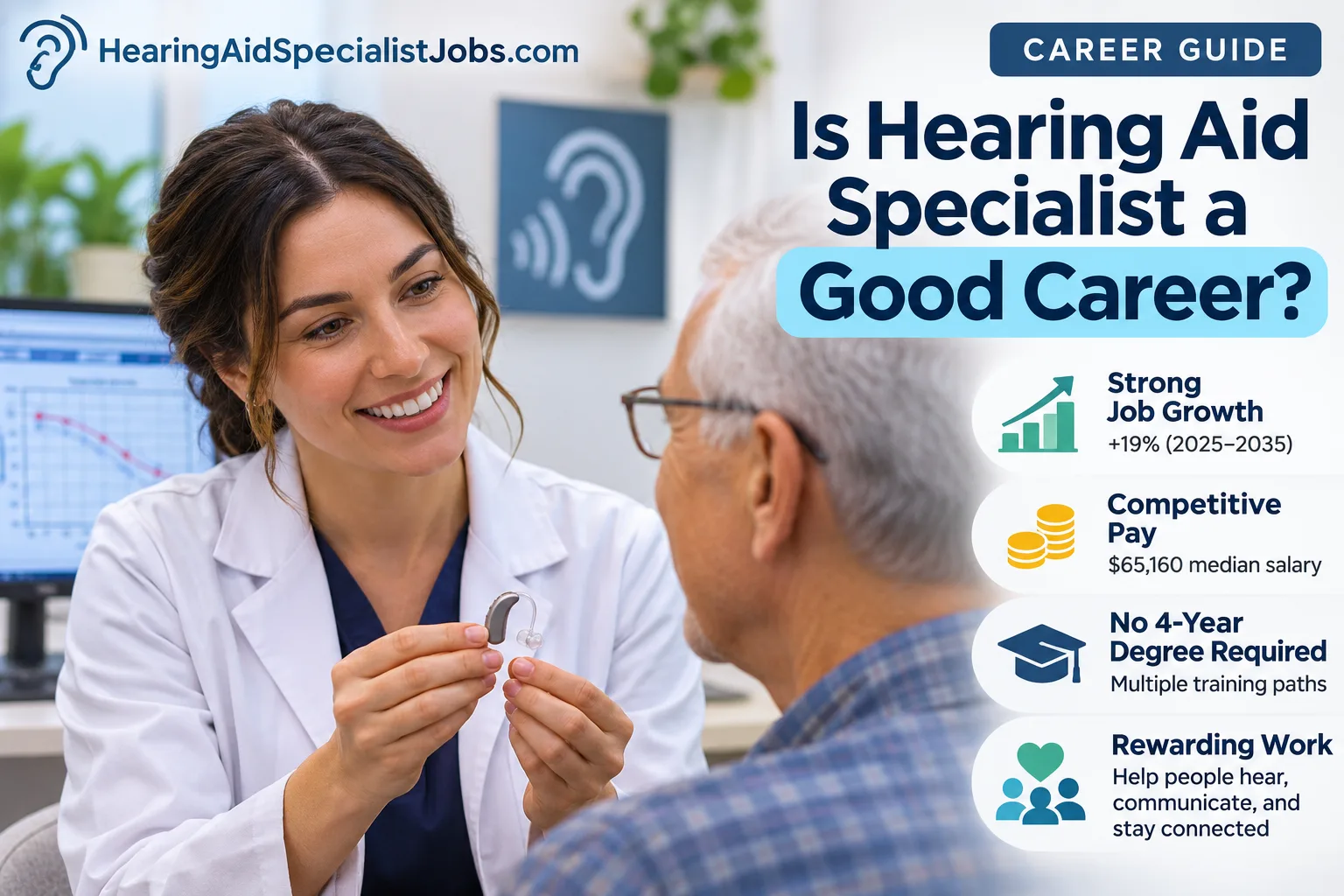
Do you need a college degree to become a Hearing Aid Specialist?
Not necessarily.
BLS lists high school diploma or equivalent as the typical entry-level education for Hearing Aid Specialists nationally and moderate-term on-the-job training as the typical training category. Bureau of Labor Statistics
However, that does not mean a high school diploma alone automatically qualifies someone for a license. State licensing requirements still control eligibility.
How much do Hearing Aid Specialists earn?
The latest BLS data report a median annual wage of $65,160 in May 2025 for Hearing Aid Specialists. Bureau of Labor Statistics
Compensation can vary by geography, experience, employer, commission structure and other factors.
What is the career outlook?
BLS estimates that approximately 11,200 Hearing Aid Specialists were employed in 2025 and projects employment to grow to roughly 13,400 by 2035, an increase of about 19%. BLS categorizes that as much faster than average. The projections table estimates roughly 900 openings per year on average during the period. Bureau of Labor Statistics
BLS also identifies an aging population and increased demand for hearing aids as factors supporting demand for the occupation. Bureau of Labor Statistics
Where can Hearing Aid Specialists work?
Jobs may be available through:
independent hearing-care practices
national hearing-care organizations
hearing-aid retailers
physician or ENT practices
healthcare organizations
multi-location hearing centers
BLS data show retail trade and healthcare as major employment sectors for the occupation. O*NET OnLine
Find Hearing Aid Specialist jobs
Once you understand your state's licensing requirements, the next step is finding employers hiring in your area.
Browse current Hearing Aid Specialist jobs nationwide →
HearingAidSpecialistJobs.com/jobs
Sources
International Hearing Society — How to Become a Hearing Aid Specialist
U.S. Bureau of Labor Statistics — Hearing Aid Specialist career data
O*NET — Hearing Aid Specialists 29-2092.00
International Hearing Society — ILE licensing exam information