Hearing Aid Specialist
Is Hearing Aid Specialist a Good Career?(2027)
Is hearing aid specialist a good career? Explore 2026 salary, 19% job growth, training, career benefits, downsides, and hearing aid specialist jobs near you.
Is Hearing Aid Specialist a Good Career? Salary, Job Outlook, Pros and Cons (2026)
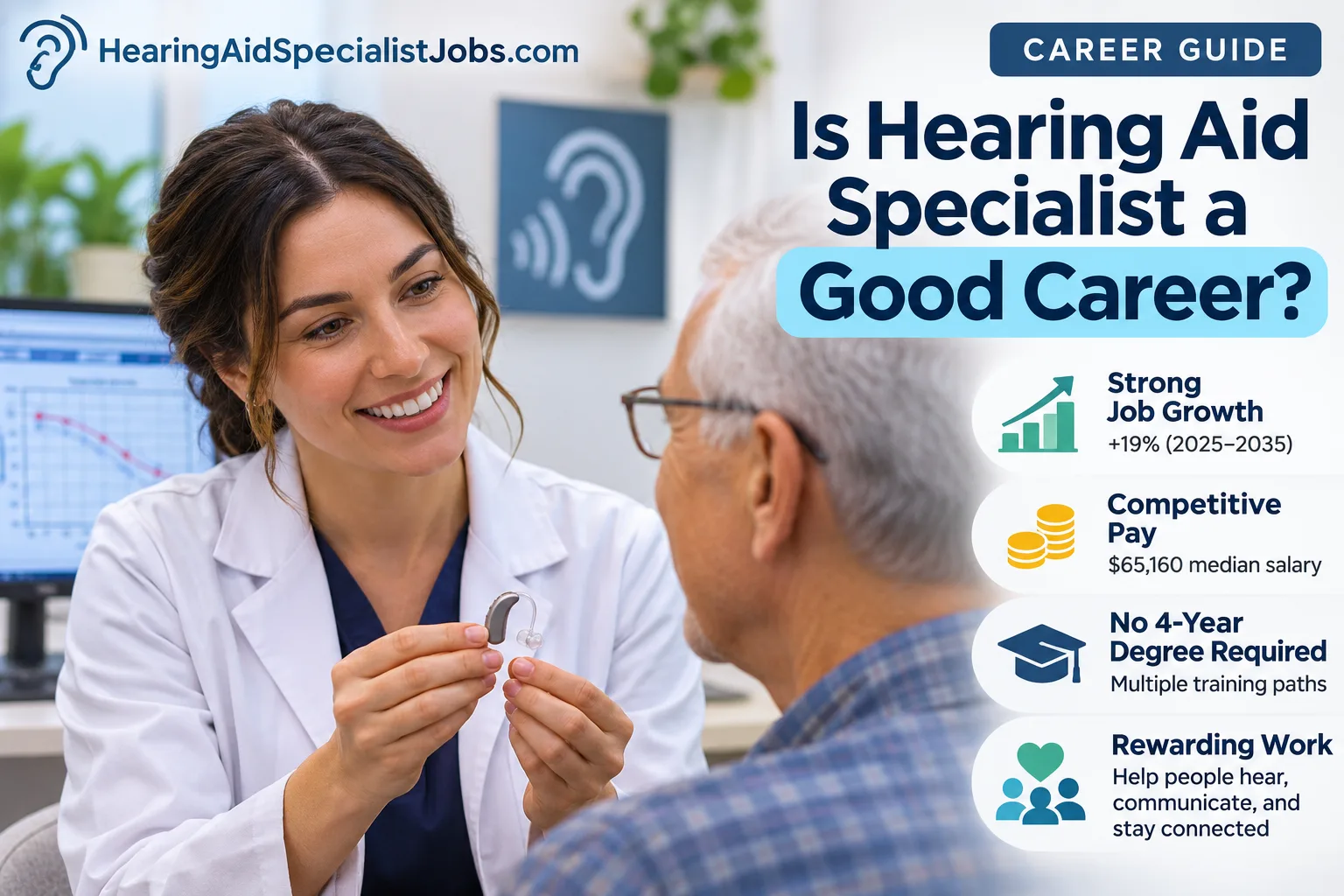
Is hearing aid specialist a good career? Yes, becoming a hearing aid specialist can be a good career for people who enjoy helping others, working with technology, and building relationships. The profession offers competitive pay, strong projected job growth, and a pathway into hearing healthcare that typically does not require a four-year college degree.
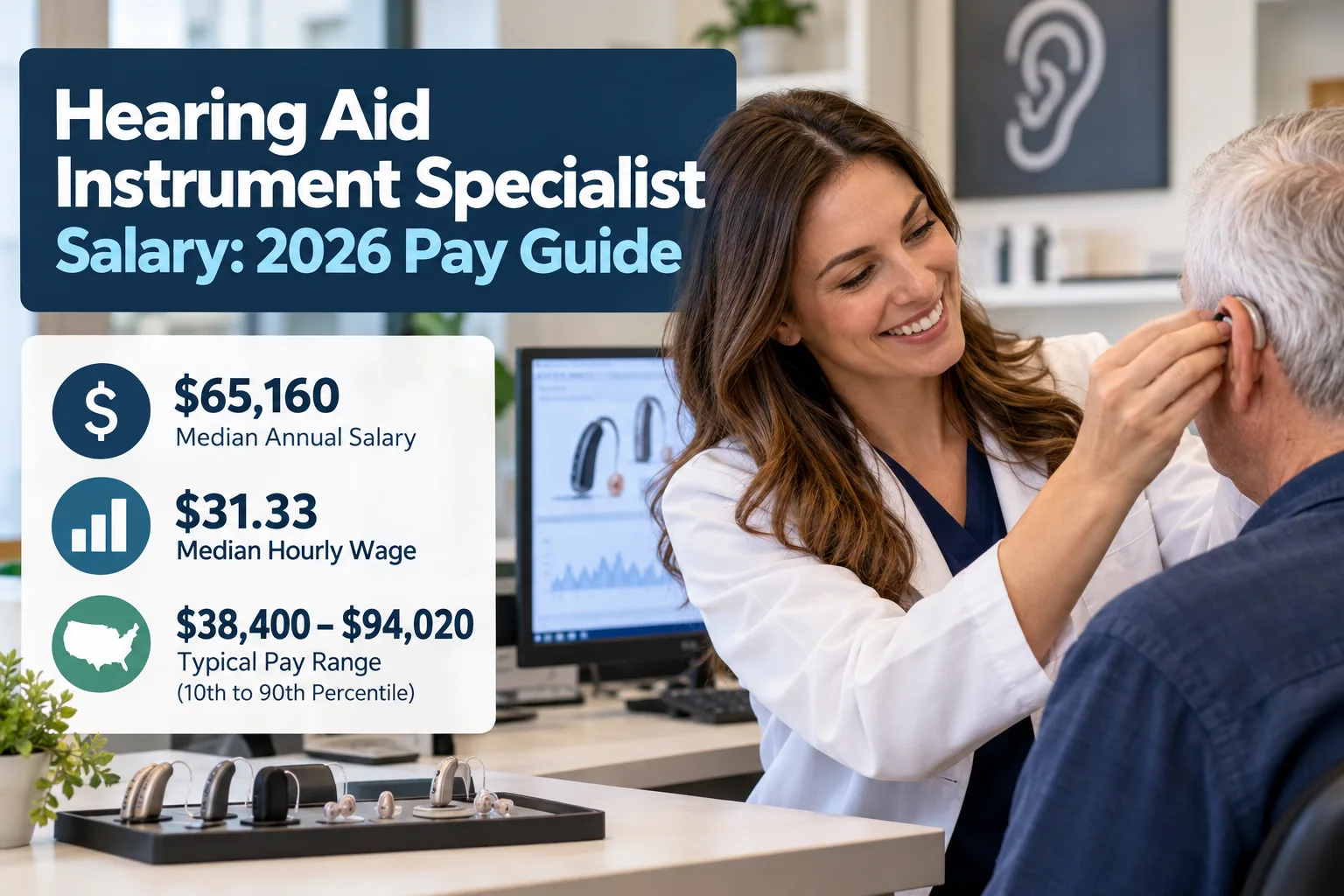
According to the U.S. Bureau of Labor Statistics (BLS), hearing aid specialists earned a median annual wage of $65,160 in May 2025, equivalent to $31.33 per hour. Employment is projected to grow 19% from 2025 to 2035, substantially faster than the average for all occupations.
However, the profession is not right for everyone. State licensing requirements, patient-facing responsibilities, and sales expectations at certain employers are important factors to consider.
This guide examines the advantages and disadvantages of becoming a hearing aid specialist, earning potential, job security, training requirements, and whether the profession is worth pursuing in 2026.
If you're already considering entering the field, you can explore opportunities through HearingAidSpecialistJobs.com, a dedicated U.S. career network for hearing-care professionals.
Is Hearing Aid Specialist a Good Career in 2026? Key Facts
Here is a snapshot of the profession based on the latest available federal occupational data.
Career factor | Hearing aid specialist |
|---|---|
Median annual salary | $65,160 |
Median hourly wage | $31.33 |
Projected job growth | 19% (2025–2035) |
Projected annual job openings | Approximately 900 |
Typical entry-level education | High school diploma or equivalent |
Typical on-the-job training | Moderate-term |
State licensing | Requirements vary by jurisdiction |
Main responsibilities | Hearing testing, hearing aid fitting, programming, client education and follow-up |
Sources: U.S. Bureau of Labor Statistics and O*NET OnLine — Hearing Aid Specialists.
These figures suggest an encouraging national career outlook, but they do not guarantee a specific salary, local job opening, or licensing timeline.
7 Reasons Hearing Aid Specialist Can Be a Good Career
1. Strong Job Growth and Long-Term Demand
One of the strongest reasons to consider a hearing aid specialist career is its projected employment growth.
The Bureau of Labor Statistics projects that employment will increase from approximately 11,200 hearing aid specialists in 2025 to 13,400 in 2035.
That represents:
19% projected employment growth
Approximately 2,200 additional positions over the decade
About 900 job openings annually on average, including openings from worker replacement
The aging U.S. population is one factor supporting demand for hearing healthcare services.
Hearing aid specialists help people manage hearing difficulties through hearing testing, hearing aid selection, fitting, and ongoing device support within their authorized scope of practice.
While employment projections are not guarantees, this growth makes hearing aid specialist a promising occupation to investigate.
For additional information, read our Hearing Aid Specialist Salary and Job Outlook guide.
2. Competitive Salary Without a Typical Four-Year Degree Requirement
Another major advantage is the relationship between education requirements and earning potential.
According to BLS data from May 2025, hearing aid specialist wages were:
Wage percentile | Annual earnings |
|---|---|
10th percentile | $38,400 |
25th percentile | $48,390 |
Median | $65,160 |
75th percentile | $80,010 |
90th percentile | $94,020 |
These are national occupational wage estimates, not starting salaries or guaranteed earnings.
Your actual compensation may depend on experience, location, employer, credentials, and compensation arrangements.
For someone entering healthcare without pursuing a bachelor's or doctoral degree, this earning potential may be attractive.
Explore our detailed Hearing Aid Instrument Specialist Salary Guide or review hearing aid specialist hourly pay.
3. Opportunities to Earn Salary Plus Commission
Some hearing aid specialist employers offer compensation packages combining a guaranteed salary with commissions or performance bonuses.
Others use primarily fixed salaries or hourly wages.
Commission-based positions may reward eligible hearing aid sales, but compensation plans vary significantly.
Before accepting an offer, ask:
Is the advertised compensation base salary or estimated total earnings?
Is commission guaranteed or dependent on performance?
Are there individual sales targets?
Are patient appointments and leads provided?
How are cancellations and returns treated?
Does the employer provide benefits and paid training?
A higher advertised earning opportunity does not automatically mean a better position. Guaranteed pay, ethical patient-care expectations, and realistic performance targets all matter.
Our Hearing Aid Specialist Commission and Salary Guide explains how different compensation arrangements work.
4. You Can Enter the Profession Without a Traditional College Degree
A common question among career changers is whether a college degree is required to become a hearing aid specialist.
The BLS identifies a high school diploma or equivalent as the occupation's typical entry-level education and lists moderate-term on-the-job training.
However, professional licensing requirements vary by state.
The International Hearing Society identifies two principal educational pathways:
Practice-based training: Learning through supervised workplace training under an appropriately qualified professional.
Academic training: Completing a hearing instrument sciences educational program.
The exact training, permits, examinations, and other qualifications required depend on the relevant licensing authority.
This flexibility can make hearing aid specialist an accessible option for individuals transitioning from retail, customer service, sales, or other careers.
For a more detailed explanation, read:
5. The Work Can Be Personally Rewarding
Hearing aid specialists often work directly with people experiencing hearing difficulties.
Their responsibilities may include conducting hearing tests, selecting and fitting appropriate hearing aids, teaching clients how to use devices, and providing follow-up support.
According to O*NET, important occupational activities include helping and caring for others, communicating directly with clients, and maintaining interpersonal relationships.
For professionals who enjoy helping people solve practical problems, the opportunity to make a difference in someone's everyday communication can be one of the most rewarding aspects of the job.
Unlike positions focused entirely on administrative tasks, hearing aid specialists can see the practical results of their work through direct client interaction.
Learn more about the typical responsibilities in our guide to Hearing Aid Specialist Duties, Skills, Training, and Jobs.
6. The Career Combines Healthcare and Technology
Hearing aid specialists work with hearing instruments that may require fitting, software-based adjustments, troubleshooting, and ongoing maintenance.
The occupation combines several skill areas:
Patient and customer communication
Hearing testing procedures
Device fitting and adjustment
Technology troubleshooting
Client education
Documentation and follow-up care
This variety can appeal to people who enjoy both technical problem-solving and working with others.
Hearing instrument technology also continues to evolve, making ongoing learning an important part of the profession.
For professionals interested in technology but not in a purely technical desk job, hearing healthcare may offer an appealing balance.
7. Multiple Employers and Career Directions
Hearing aid specialists may work for independent hearing care clinics, national hearing healthcare providers, hearing aid retailers, and other organizations offering hearing instrument services.
After gaining experience, professionals may pursue senior dispensing roles, clinic management, training, or other responsibilities, depending on their qualifications and the opportunities available.
Some professionals may also consider owning or operating a hearing-care business, subject to applicable licensing and business requirements.
Job titles can vary across employers and jurisdictions.
When researching opportunities, consider searching for:
These titles are often used for closely related occupations, although individual positions and licensing requirements may differ.
What Are the Disadvantages of Being a Hearing Aid Specialist?
Despite the advantages, there are several challenges worth considering before entering the profession.
1. Licensing Requirements Differ by State
There is no single hearing aid specialist license that automatically authorizes dispensing in every U.S. state.
Depending on the jurisdiction, candidates may need to complete supervised training, obtain a trainee permit, pass licensing examinations, and satisfy other requirements.
Moving to another state can also require additional steps.
Before choosing a training program or accepting a position, confirm the rules with the appropriate state licensing agency.
You can learn about examination requirements in our Hearing Aid Specialist ILE Licensing Exam Guide.
2. Some Positions Have Sales Expectations
Although hearing aid specialists provide important hearing-care services, some employers also expect employees to meet sales or revenue targets.
This can create pressure for professionals who prefer purely technical or clinical responsibilities.
The intensity of sales expectations varies by employer.
Before applying, review the job description carefully and ask how the organization balances patient care, performance measurements, and sales incentives.
3. The Work Requires Strong Communication Skills
Hearing aid specialists frequently interact with clients and their families.
They may need to explain hearing test results within their authorized scope, demonstrate technology, answer questions, and troubleshoot problems.
Patients can have different expectations, communication preferences, and levels of comfort with hearing technology.
If you prefer working independently with very limited interpersonal interaction, this career may not be an ideal match.
4. Most Traditional Positions Require In-Person Work
Hearing testing, earmold impressions, physical device fitting, and many follow-up services require direct client interaction.
Consequently, candidates seeking exclusively remote work may find traditional hearing aid specialist roles limiting.
Some organizations may offer positions involving remote support or other nontraditional responsibilities, but applicants should verify the actual duties and work arrangement.
5. You Must Keep Learning
Hearing instrument technology, product options, and professional standards continue to develop.
License maintenance and continuing education requirements can also apply, depending on the jurisdiction.
Professionals should be prepared to keep their knowledge current throughout their careers.
Is Being a Hearing Aid Specialist Stressful?
Being a hearing aid specialist can be stressful, particularly in positions with demanding appointment schedules, sales targets, or challenging client interactions.
Potential sources of stress include meeting patient expectations, managing device problems, explaining pricing, and balancing administrative responsibilities with client care.
However, the experience varies by workplace.
A clinic with structured appointments, supportive management, and clear clinical procedures may offer a different work environment from a high-volume retail operation with aggressive sales targets.
When interviewing, ask about appointment length, daily patient volume, training support, staffing, and performance expectations.
The best way to evaluate job stress is to examine the specific employer and position rather than judging the entire profession by one workplace.
Is Hearing Aid Specialist a Good Career for Someone Changing Careers?
Yes, hearing aid specialist can be worth considering for career changers, especially those with customer-facing experience.
Transferable skills may include:
Previous experience | Potentially useful skill |
|---|---|
Retail | Customer service and product explanations |
Sales | Relationship building and consultation |
Healthcare support | Client communication and documentation |
Customer service | Problem-solving and patience |
Technical support | Troubleshooting and explaining technology |
Management | Scheduling, operations, and team leadership |
These skills do not replace licensing or technical training. However, they may help candidates adjust to the interpersonal and operational aspects of hearing-care work.
If you are new to the industry, explore our How to Become a Hearing Aid Specialist guide for a practical overview of entry pathways.
Hearing Aid Specialist vs. Audiologist: Which Is a Better Career?
Both professions help people with hearing-related needs, but their education requirements and scopes of practice are different.
Career factor | Hearing aid specialist | Audiologist |
|---|---|---|
Typical entry education | High school diploma or equivalent, with additional requirements depending on state | Doctor of Audiology (Au.D.) degree |
Licensing | State-specific dispensing requirements | State audiology licensure |
Main focus | Hearing aid selection, fitting, dispensing and follow-up care | Broader hearing and balance assessment and management |
Training commitment | Varies by jurisdiction and pathway | Extensive university and clinical education |
Scope of practice | Defined by applicable dispensing laws | Defined by applicable audiology laws |
A hearing aid specialist career may appeal to someone seeking a shorter educational entry path.
Audiology may be better suited to someone who wants broader clinical responsibilities and is prepared to complete doctoral education.
Neither career is automatically better. The right choice depends on your goals, interests, finances, and willingness to complete the required education.
Read our comparison of Hearing Aid Specialist vs. Hearing Instrument Specialist vs. Audiologist or browse Audiologist Jobs.
Where Are Hearing Aid Specialist Jobs Available?
Hearing aid specialist opportunities exist across the United States, but the number of openings and required credentials can vary significantly by location.
For candidates seeking opportunities close to home, state-specific job searches are a practical starting point.
Explore our Hearing Aid Specialist Jobs by State directory to browse hearing-care positions nationwide.
You can also explore individual state job pages:
These pages provide location-specific job listings, not rankings of the best states for employment.
Before choosing where to work, compare local availability, licensing requirements, cost of living, compensation, and employer training opportunities.
Is Hearing Aid Specialist a Good Career for the Future?
Current employment projections are favorable.
BLS projects 19% employment growth between 2025 and 2035, indicating substantial projected growth relative to the average U.S. occupation.
However, prospective specialists should also consider changes in hearing aid technology and distribution.
For example, the U.S. Food and Drug Administration permits qualifying over-the-counter hearing aids for adults aged 18 or older with perceived mild-to-moderate hearing loss. These products can be purchased without visiting a licensed hearing healthcare professional.
That introduces an additional way for consumers to access hearing aids.
At the same time, traditional hearing aid specialists perform tasks such as fitting devices, counseling clients, and providing ongoing support.
It is not possible to guarantee how technology, retail changes, or automation will affect individual hearing-care positions.
The strongest long-term approach is to develop technical proficiency, communication skills, ethical professional judgment, and the ability to adapt to changing hearing healthcare services.
For a related discussion, see Is Becoming a Hearing Aid Specialist Worth It in 2026?.
How to Start a Hearing Aid Specialist Career
If this profession sounds like a good fit, consider the following steps.
Step 1: Research your state's licensing requirements.
Identify the relevant regulatory agency and review its educational, training, examination, and application requirements.
Step 2: Choose an approved training route.
Depending on the jurisdiction, this may involve supervised workplace training or academic preparation.
Step 3: Look for trainee or apprenticeship opportunities.
Some employers may offer structured training opportunities for applicants who are not yet fully licensed.
Step 4: Complete required examinations and licensure.
Follow your state authority's requirements before performing services that require a professional license.
Step 5: Compare employers and compensation.
Evaluate training support, salary, commissions, benefits, career development, and workplace expectations.
Step 6: Search related job titles.
Employers may advertise similar opportunities under hearing aid specialist, hearing instrument specialist, or hearing aid dispenser.
For more detailed information, see our Hearing Instrument Specialist Training Timeline and explore Hearing Aid Specialist Trainee and Apprenticeship Opportunities.
Frequently Asked Questions About Hearing Aid Specialist Careers
Is hearing aid specialist a good career?
Yes, hearing aid specialist can be a good career for people who enjoy helping others and working with technology. The profession has a $65,160 national median annual wage and 19% projected employment growth from 2025 to 2035. However, licensing requirements, client interaction, and employer expectations should be considered.
Is becoming a hearing aid specialist worth it?
It can be worth it for individuals seeking a healthcare-related career without the typical requirement to complete a four-year degree. Whether it is worthwhile depends on local earnings, training costs, licensing requirements, and personal career goals.
Do hearing aid specialists make good money?
Hearing aid specialists earned a median annual wage of $65,160 in May 2025, according to BLS data. The 75th-percentile wage was $80,010, and the 90th-percentile wage was $94,020. Actual earnings vary by location and employer.
Can hearing aid specialists make $100,000 a year?
Some compensation arrangements may allow earnings of $100,000 or more, but this should not be considered a typical outcome. The national 90th-percentile wage was $94,020 in May 2025. Carefully review actual compensation plans rather than assuming commission or bonuses will reach a specific amount.
Are hearing aid specialists in demand?
National employment projections indicate growing demand. BLS expects hearing aid specialist employment to increase by approximately 19% between 2025 and 2035, with about 900 annual openings on average. Local demand varies.
Is it hard to become a hearing aid specialist?
The difficulty depends on state requirements and individual preparation. Candidates may need supervised training, licensing examinations, and practical technical skills. A four-year degree is not the typical national entry-level education requirement, but professional competence and licensure are still important.
Is hearing aid specialist a sales job?
Some positions have a significant sales component, while others place different emphasis on patient services, testing, fitting, and follow-up care. Employers may offer salaries, commissions, bonuses, or combinations of these compensation methods.
Do hearing aid specialists need a degree?
A college degree is not universally required. The BLS lists a high school diploma or equivalent as the typical entry-level education, but state licensing authorities may require specific education, training, or examinations.
Can you become a hearing aid specialist with no experience?
Some candidates enter the field through supervised workplace training or trainee positions. Requirements differ by jurisdiction, and not every employer offers entry-level training.
Can hearing aid specialists work remotely?
Most traditional hearing aid dispensing responsibilities involve in-person services, including hearing testing and device fitting. Remote or hybrid opportunities may exist for particular support or related roles, but applicants should verify the duties and employment arrangement.
What is the difference between a hearing aid specialist and a hearing instrument specialist?
The titles are commonly used for closely related hearing aid dispensing occupations. Actual terminology, professional authorization, and licensing requirements vary by jurisdiction.
What is the future of hearing aid specialist jobs?
The BLS projects strong employment growth through 2035. However, technology, consumer purchasing options, and industry practices may change. Maintaining current technical knowledge and strong client-care skills will remain important for professional development.
Final Verdict: Is Hearing Aid Specialist a Good Career?
For the right person, hearing aid specialist is a promising career worth exploring in 2026.
The strongest advantages include projected employment growth, competitive median pay, accessible training pathways, and the opportunity to help people with hearing difficulties.
The main disadvantages involve state licensing requirements, substantial client interaction, potential sales pressure, and the need for continuing education.
If you enjoy working with people, learning new technology, and solving practical problems, this profession may offer a rewarding career direction.
The next step is to compare actual opportunities in your area and determine which employers offer the training, compensation, and work environment you want.
Ready to explore hearing healthcare careers?
Visit HearingAidSpecialistJobs.com to discover hearing-care opportunities across the United States, or browse hearing aid specialist jobs by state to focus your search geographically.
You can also explore our complete Hearing Care Career Guides for additional resources on salaries, training, licensing, and professional development.
Sources and Methodology
This article uses federal occupational data and professional association information available as of November 2026.
U.S. Bureau of Labor Statistics — Occupational Data for Hearing Aid Specialists — May 2025 median wages, typical entry education, and 2025–2035 employment projections.
O*NET OnLine — Hearing Aid Specialists (29-2092.00) — Occupational duties, skills, work activities, and labor-market information.
International Hearing Society — How to Become a Hearing Aid Specialist — Training pathways, professional preparation, and licensing considerations.
U.S. Food and Drug Administration — Hearing Aids — Regulatory information about over-the-counter and prescription hearing aids.
Career information disclaimer: This article provides general educational and occupational information. Salary estimates are national statistics, not guaranteed compensation. Professional licensing requirements vary by state and may change. Verify current requirements with the applicable licensing authority.