Licensing
Hearing Aid Specialist Exam: ILE Licensing Exam Guide for 2026
Learn how the ILE works for Hearing Aid Specialist licensure, including the exam format, topic areas, scoring method, and the difference between course scores and licensing results.
Hearing Aid Specialist Exam: ILE Licensing Exam Guide for 2026
The Hearing Aid Specialist exam is one of the major steps toward licensure in many U.S. states.
For many candidates, that written licensing examination is the International Licensing Examination for Hearing Healthcare Professionals, usually called the ILE.
The ILE is owned and administered by the International Hearing Society and is used as the written licensing examination for Hearing Aid Specialists in a majority of U.S. states. The current IHS list identifies 43 states using the ILE.
Licensing itself is still controlled by each state, so passing the exam is only one part of the process.
If you are researching the profession from the beginning, start with our guide to how to become a Hearing Aid Specialist. If you are already training and trying to estimate the overall timeline, see how long it takes to become a Hearing Instrument Specialist.
This guide explains:
what the ILE is
how many questions are on the exam
how long you have to complete it
the five major exam domains
how ILE scoring works
the difference between the ILE and the IHS course examination
how to prepare
what happens after you pass
how the exam fits into the overall Hearing Aid Specialist career path
What Is the Hearing Aid Specialist ILE Exam?
The International Licensing Examination for Hearing Healthcare Professionals is a written licensing examination designed to assess whether an entry-level hearing aid professional has the knowledge needed to practice safely and effectively within the applicable scope of practice.
It is not simply a vocabulary or memorization test.
IHS describes the examination as practice-based. Candidates are expected to understand important concepts and apply them to realistic professional situations.
Questions may ask you to:
interpret assessment information
choose an appropriate testing process
recognize when referral may be appropriate
select appropriate hearing devices
determine fitting approaches
troubleshoot hearing instruments
make decisions involving follow-up care
The exam is only one component of licensure.
Your state licensing authority determines whether you are eligible to take it and what other requirements you must complete.
If you are still trying to understand how exams fit into the overall pathway, read our complete Hearing Aid Specialist career and licensing guide.
Candidates entering through workplace training should also review our guide to Hearing Aid Specialist apprenticeships and trainee jobs.
ILE Exam Format
According to the current January 2026 IHS Study Guide, the examination includes:
Exam Feature | Current ILE Format |
|---|---|
Exam type | Multiple choice |
Total questions | 105 |
Scored questions | 80 |
Unscored pilot questions | 25 |
Time allowed | 120 minutes |
Exam style | Practice-based and scenario-oriented |
Result | Pass/Fail |
Licensing authority | State or provincial licensing agency |
Source: International Hearing Society — ILE Study Guide
The 25 pilot questions are mixed with the scored questions.
That means candidates do not know which questions are scored and which are unscored while taking the examination.
With 105 questions and 120 minutes, you have a little over one minute per question if you use the entire testing period.
What Topics Are on the Hearing Aid Specialist Exam?
The current ILE competency model divides the scored examination into five major areas.
ILE Competency Domain | Exam Weight |
|---|---|
Conduct Patient/Client Assessment | 21% |
Interpret and Apply Assessment Results | 22% |
Select Hearing Devices | 18% |
Fit and Dispense Hearing Devices | 20% |
Provide Continuing Care | 19% |
Source: International Hearing Society — ILE Exam Outline
These categories closely reflect the actual work performed in the profession.
If you are researching the day-to-day role as well as the test material, our guide to Hearing Aid Specialist duties, skills, training and jobs explains what specialists actually do after becoming licensed.
1. Conduct Patient/Client Assessment — 21%
This portion of the examination includes topics involving:
infection-control procedures
patient or client history
otoscopic inspection
audiometric testing
air-conduction testing
bone-conduction testing
speech audiometry
masking
immittance or tympanometry information where applicable
The audiometric-testing portion represents an important part of this competency area.
Candidates need more than the ability to recognize terminology. They should understand how these concepts are applied in a hearing-care environment.
2. Interpret and Apply Assessment Results — 22%
At 22%, this is currently the largest exam domain.
Candidates may need to:
interpret audiometric results
identify types of hearing loss
identify configurations of hearing loss
determine whether someone may be a candidate for amplification
recognize findings that may require referral
apply assessment information to hearing-device decisions
This is another reason hands-on training is important.
IHS states that because the ILE is practice-based, clinical experience is an important part of preparation.
For candidates pursuing an employer-based pathway, read our guide to Hearing Aid Specialist trainee and apprenticeship opportunities.
3. Select Hearing Devices — 18%
This section covers concepts involved in selecting appropriate hearing technology.
Topics may include:
hearing-instrument selection
patient listening needs
lifestyle considerations
audiometric results
physical and acoustic considerations
fitting objectives
earmolds
acoustic coupling
ear impressions
The role therefore combines technical knowledge with the ability to understand individual patient needs.
If you are deciding whether this type of work appeals to you, see Is Hearing Aid Specialist a Good Career?.
4. Fit and Dispense Hearing Devices — 20%
Candidates may be tested on concepts involving:
programming hearing instruments
adjusting devices
checking physical fit
evaluating acoustic fit
explaining device operation
orienting patients to hearing aids
verification
validation
speech mapping
real-ear measurement
The ILE competency model includes fitting-verification concepts such as speech mapping and real-ear measurement.
These topics reflect an important distinction between simply knowing what a hearing aid is and being trained to professionally fit and dispense hearing technology.
5. Provide Continuing Care — 19%
The job does not end when a hearing aid is first fitted.
This domain covers areas such as:
counseling
aural rehabilitation
patient expectations
communication strategies
hearing-instrument maintenance
troubleshooting
follow-up care
electroacoustic analysis
Long-term patient care is a significant part of many Hearing Aid Specialist positions.
You can see how employers describe these responsibilities by browsing current Hearing Aid Specialist jobs.
How Does the ILE Exam Process Work?
The exact licensing process depends on the state.
According to IHS, the general process is:
Your state licensing agency determines whether you meet the eligibility requirements.
IHS receives confirmation that you are eligible.
You receive instructions for establishing your test-taker account.
You create and validate the account.
You schedule the examination.
You pay the applicable examination fee.
You take the ILE.
Your result is reported according to the procedure required by your licensing jurisdiction.
Your licensing agency determines what additional steps are necessary.
The last point is especially important.
Passing the ILE does not automatically mean you are fully licensed.
Depending on the state, additional requirements may involve:
supervised training
practical examinations
applications
licensing fees
trainee permits
background checks
continuing education
state-specific examinations
other administrative requirements
If you are trying to understand how all of those steps fit together, compare our guides on how long it takes to become a Hearing Aid Specialist and how long it takes to become a Hearing Instrument Specialist.
What Score Do You Need to Pass the ILE?
This is one area where candidates can easily find misleading information online.
You should not assume there is one fixed percentage that represents the ILE passing score.
IHS explains that examination forms can vary slightly in difficulty. A statistical equating process is used to maintain a consistent competency standard.
Candidates receive a Pass or Fail result rather than a percentage score.
IHS has a recommended passing standard, but the licensing authority ultimately determines what constitutes passing for licensure.
Source: IHS — ILE Exam Results and Scoring
Is 72% the ILE Passing Score?
No.
You may see 72% mentioned when researching IHS education.
That number refers to the final examination associated with the IHS Distance Learning for Professionals in Hearing Health Sciences Course.
It is not the same examination as the licensing ILE.
The distinction is:
IHS Distance Learning Course final exam ≠ International Licensing Examination
Candidates should therefore not assume that answering 72% of ILE questions correctly automatically results in a passing licensing score.
What Should You Study for the ILE?
The best starting point is the official IHS ILE Study Guide and Competency Model.
IHS states that candidates should understand and be able to apply the concepts included in the exam blueprint.
The current competency areas include:
Patient/client assessment
Interpretation of assessment results
Hearing-device selection
Fitting and dispensing
Continuing care
IHS also recommends combining formal study with hands-on hearing healthcare experience.
That is particularly relevant because many people enter the occupation through employer-based or supervised training.
If you have not entered training yet, see:
Hearing Aid Specialist Apprenticeships and Trainee Jobs
Candidates wondering whether college is necessary should also read:
Can You Become a Hearing Aid Specialist Without a Degree?
A four-year degree is not universally required for this occupation, but training and licensing requirements vary by jurisdiction.
Does IHS Offer Official ILE Test Prep?
Yes.
IHS offers an official ILE Test Prep platform.
According to IHS, the platform uses previously administered examination questions that will not appear again on the licensing examination.
The purpose is to help candidates become familiar with:
examination style
question structure
application-based reasoning
test-taking process
IHS specifically warns that test preparation materials are not a substitute for proper training or education.
That is important because the ILE is designed to test applied professional knowledge rather than memorization alone.
How Hard Is the Hearing Aid Specialist Exam?
There is no reliable national statistic that can tell an individual candidate exactly how difficult they will find the exam.
What the official IHS materials make clear is that memorization alone is unlikely to be sufficient.
Candidates are expected to apply concepts involving:
assessment
audiometric interpretation
hearing loss
device selection
hearing-aid fitting
verification
counseling
troubleshooting
continuing care
Someone completing supervised hands-on training while learning the underlying material is therefore preparing in the way IHS recommends.
If you are at the beginning of that process, our Hearing Aid Specialist training and apprenticeship guide explains how workplace training can work.
Do All States Use the ILE?
No.
The current IHS licensing-agency list identifies 43 U.S. states using the ILE.
States currently listed by IHS as not using the ILE include:
Alaska
California
Michigan
New York
Pennsylvania
Vermont
Utah
The District of Columbia is also listed separately among jurisdictions not using the ILE.
Source: International Hearing Society — Current ILE Licensing Agencies
This is why you should never assume that the licensing process in one state applies to another.
Your state may have:
a different written examination
a practical examination
different trainee requirements
different supervised-training requirements
different education requirements
additional state-specific testing
Always verify current requirements directly with the licensing authority in the jurisdiction where you intend to work.
Do You Need a Degree Before Taking the Hearing Aid Specialist Exam?
Not universally.
The U.S. Bureau of Labor Statistics lists a high school diploma or equivalent as the typical entry-level education for Hearing Aid Specialists nationally and moderate-term on-the-job training as the typical training requirement.
That does not mean every state has identical licensing rules.
The difference is important:
Typical national education level ≠ individual state licensing requirement.
Some candidates enter through supervised workplace training while others use academic hearing-instrument-science programs.
Read our full explanation:
Can You Become a Hearing Aid Specialist Without a Degree?
You can also read How to Become a Hearing Aid Specialist in 2026 for the complete career pathway.
Hearing Aid Specialist vs. Hearing Instrument Specialist: Is the Exam Different?
The terminology can be confusing because employers and licensing jurisdictions use different titles.
Common titles include:
Hearing Aid Specialist
Hearing Instrument Specialist
Hearing Instrument Dispenser
Hearing Aid Dispenser
Licensed Hearing Instrument Specialist
Hearing Care Specialist
These titles can refer to closely related dispensing roles, although the legal title and scope of practice depend on the jurisdiction.
For a detailed comparison, read:
Hearing Aid Specialist vs. Hearing Instrument Specialist vs. Audiologist
That distinction also matters when searching for employment because employers may advertise essentially related positions under different job titles.
For that reason, candidates should search multiple job pages:
Or browse all current hearing-care jobs.
When Do You Receive Your ILE Results?
Result procedures depend partly on the licensing jurisdiction.
IHS explains that some candidates can receive results through the applicable examination process, while certain jurisdictions require the result to be sent directly to the licensing agency.
For those jurisdictions, IHS may be contractually prohibited from giving the result directly to the candidate.
The examination result itself is reported as:
Pass or Fail
Your licensing agency then determines the next step.
What Happens After You Pass the ILE?
Passing the ILE can satisfy the written-examination component of the licensing process in jurisdictions that use it.
It does not automatically create a professional license.
Depending on your state, you may still need to complete requirements involving:
supervised experience
practical testing
application paperwork
fees
background checks
other state requirements
Once licensed, you can begin comparing positions advertised for Hearing Aid Specialists and related titles.
Browse:
Current Hearing Aid Specialist Jobs →
You may also want to compare the national pay data before evaluating offers.
Our Hearing Aid Specialist hourly pay guide explains current hourly and annual wage benchmarks.
For jobs with variable compensation, read our guide to Hearing Aid Specialist salary, commission and bonuses.
Is Becoming Licensed Worth the Effort?
That depends on your career goals, but current labor-market data make the occupation worth investigating.
According to the U.S. Bureau of Labor Statistics:
2025 employment: approximately 11,200
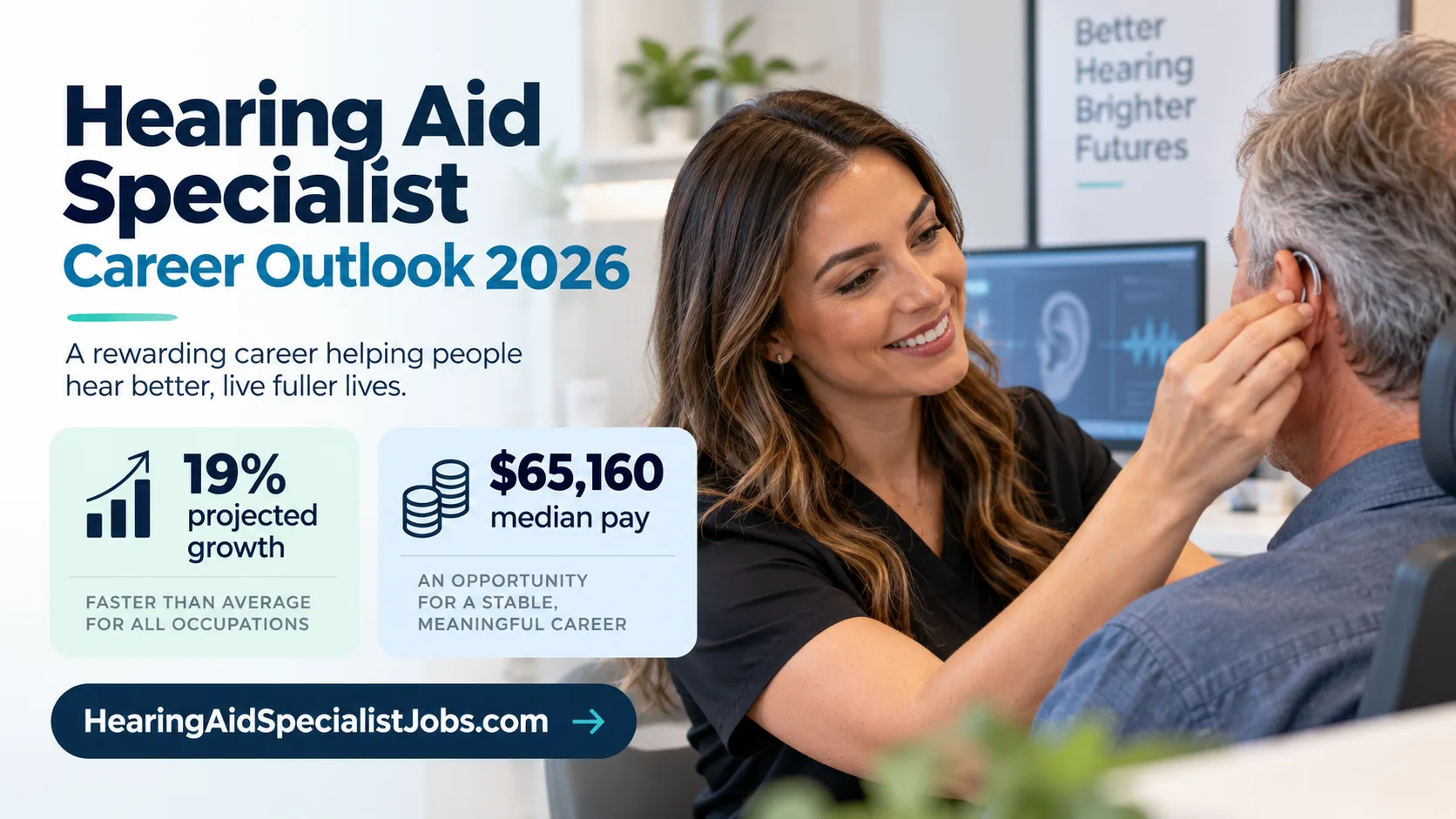
2025 median annual wage: $65,160
Projected employment in 2035: approximately 13,400
Projected growth: 19%
Projected new jobs: approximately 2,200
Typical entry-level education: high school diploma or equivalent
Typical on-the-job training: moderate-term on-the-job training
Source: U.S. Bureau of Labor Statistics
BLS classifies the projected 19% employment growth as much faster than average.
Before making a career decision, you may also want to read:
These guides cover the financial and career questions that often come immediately after researching the licensing exam.
How Long Does It Take to Become Licensed?
There is no single nationwide timeline.
The process can involve:
finding a training employer
obtaining a trainee or apprentice permit
completing supervised training
completing education or coursework
becoming eligible for examinations
preparing for the ILE or another required examination
passing examinations
submitting a licensing application
completing state-specific requirements
receiving approval from the licensing authority
For candidates searching specifically under the Hearing Instrument Specialist title, read:
How Long It Takes to Become a Hearing Instrument Specialist →
We also have a separate guide explaining how long it takes to become a Hearing Aid Specialist.
Find Hearing Aid Specialist Jobs and Trainee Opportunities
Studying the career path is useful, but current employer listings can show you what qualifications companies are actually requesting.
At HearingAidSpecialistJobs.com, you can search hearing-care opportunities across the United States.
Browse by role:
Hearing Instrument Specialist Jobs →
Or search all current hearing-care jobs.
If you have not yet completed licensing, start with our guide to Hearing Aid Specialist apprenticeships and trainee jobs.
For more career research, browse the complete Hearing Care Career Guides library.
Frequently Asked Questions
How many questions are on the Hearing Aid Specialist ILE exam?
The current ILE contains 105 multiple-choice questions. Eighty questions are scored and 25 are unscored pilot questions. Candidates have 120 minutes to complete the examination.
Source: International Hearing Society
How long is the ILE exam?
Candidates currently receive 120 minutes, or two hours, to complete the 105-question examination.
Is the ILE a practical exam?
The ILE is a written multiple-choice examination, but IHS describes it as practice-based because candidates must apply knowledge to realistic professional situations.
Your state may separately require a practical examination or other testing.
Is 72% the passing score for the ILE?
No universal 72% ILE passing score should be assumed.
The 72% figure associated with IHS applies to the final exam for its Distance Learning Course, not the licensing ILE.
ILE results are reported as Pass or Fail.
Can I schedule the ILE whenever I want?
Generally, no.
Your licensing agency first determines whether you are eligible to take the examination. After IHS receives confirmation of eligibility, the candidate receives scheduling instructions.
Does passing the ILE make me a licensed Hearing Aid Specialist?
Not automatically.
The ILE is one component of the licensing process. Your state licensing authority determines all requirements for obtaining a license.
Do I need a bachelor's degree before taking the exam?
Not universally.
BLS lists a high school diploma or equivalent as the typical entry-level education nationally, but individual state licensing requirements vary.
Read Can You Become a Hearing Aid Specialist Without a Degree? for a detailed explanation.
Can I work while training for the Hearing Aid Specialist exam?
Potentially.
Many candidates enter through practice-based training under an experienced or licensed professional, subject to the applicable state rules.
Our Hearing Aid Specialist apprenticeship and trainee guide explains this pathway in more detail.
How much can I earn after becoming licensed?
The latest BLS data reports a national median annual wage of $65,160 for Hearing Aid Specialists.
Actual compensation depends on location, employer, experience, licensing status and compensation structure.
See our Hearing Aid Specialist salary and job outlook guide for more detail.
Bottom Line
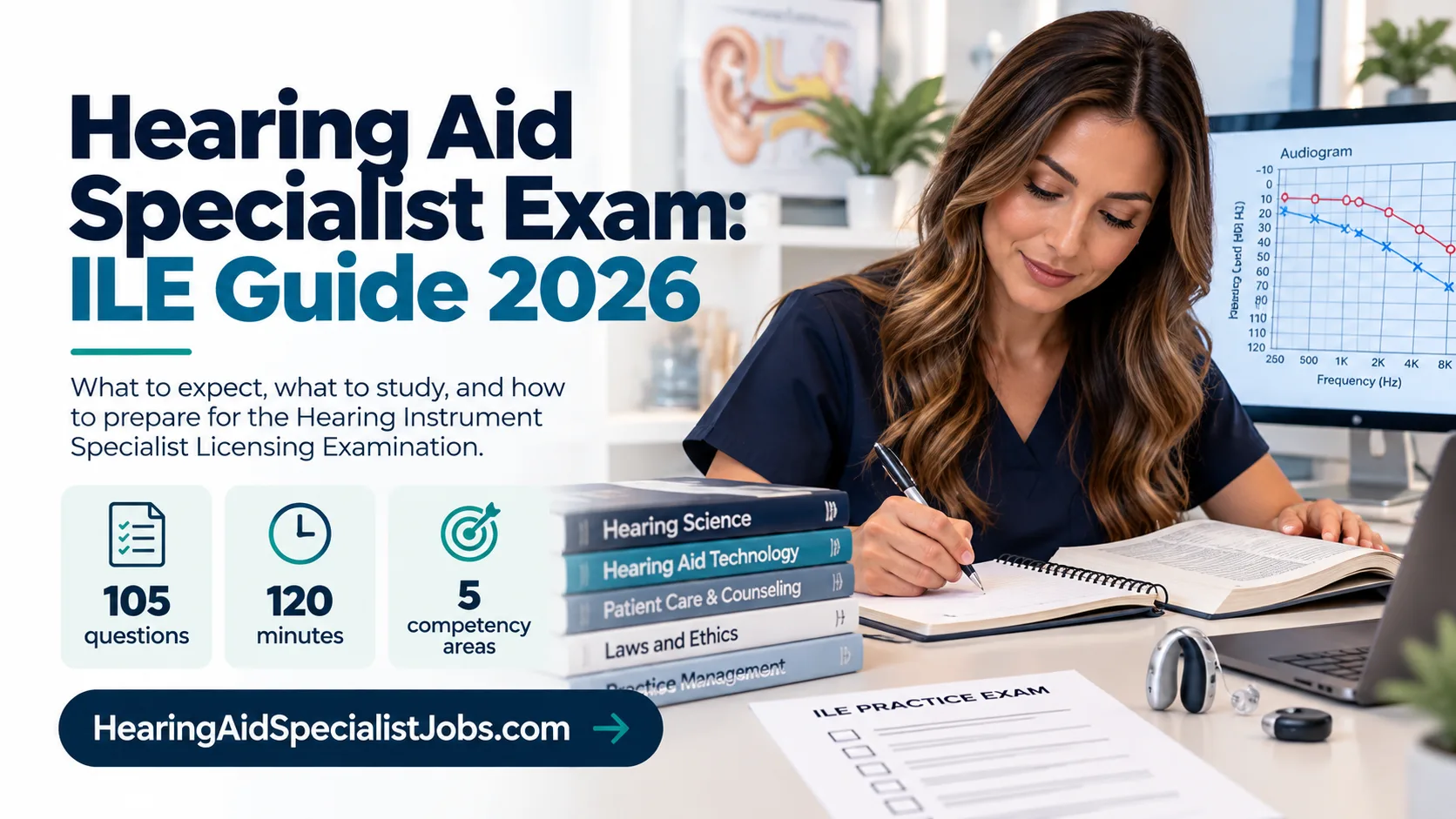
The Hearing Aid Specialist ILE is a 105-question, two-hour licensing examination used by many U.S. states.
Eighty questions are scored, 25 are unscored pilot questions, and the examination focuses on five major competency areas covering assessment, interpretation, device selection, fitting and dispensing, and continuing care.
But the exam is only one piece of the career path.
If you are starting from the beginning:
Learn how to become a Hearing Aid Specialist →
If you are trying to estimate the training timeline:
See how long it takes to become a Hearing Instrument Specialist →
If you are ready to see what employers require:
Browse Hearing Aid Specialist Jobs →
And for jobs, licensing guides, salary information and hearing-care career resources, visit HearingAidSpecialistJobs.com.
Sources and References
International Hearing Society — January 2026 ILE Study Guide
International Hearing Society — ILE Exam Outline and Competency Model
International Hearing Society — Licensing Agencies Using the ILE
U.S. Bureau of Labor Statistics — Fastest Growing Occupations
Career and licensing disclaimer: Licensing requirements vary by jurisdiction and can change. This guide provides general career information and should not be treated as a substitute for requirements published by the licensing authority where you intend to practice.