Salary & Compensation
Hearing Aid Specialist Hourly Pay and Job Outlook
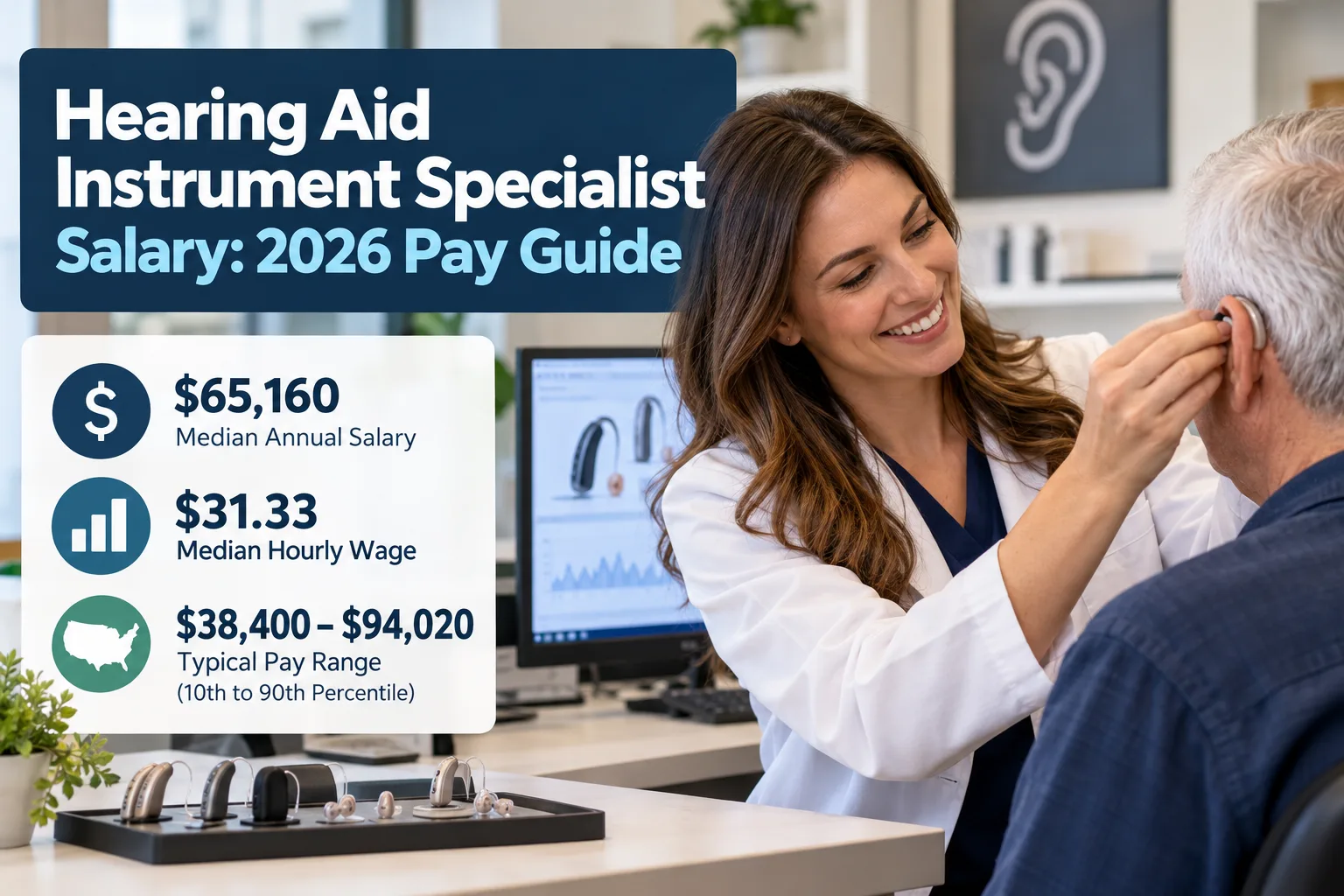
National BLS data puts the median hourly wage for Hearing Aid Specialists at $31.33, with a median annual wage of $65,160. Pay can vary by location, experience, licensing status, employer, and compensation structure.
Hearing Aid Specialist Hourly Pay and Job Outlook
National BLS data puts the median hourly wage for Hearing Aid Specialists at $31.33 per hour, with a median annual wage of $65,160. Actual compensation can vary based on location, experience, licensing status, employer and whether the position includes commission or other incentives.
If you are researching the career as well as the pay, see our guide to how long it takes to become a Hearing Instrument Specialist, or compare compensation directly in current Hearing Aid Specialist job openings.
How Much Do Hearing Aid Specialists Make Per Hour?
The latest national wage data puts the median hourly wage for Hearing Aid Specialists at $31.33 per hour.
According to the U.S. Bureau of Labor Statistics' May 2025 wage data:
Median hourly wage: $31.33
Mean hourly wage: $31.91
Median annual wage: $65,160
Mean annual wage: $66,370
Source: U.S. Bureau of Labor Statistics
The median and mean are different measurements, which is why the numbers are not identical.
The median represents the midpoint of the wage distribution, while the mean represents the mathematical average.
What Does $31.33 Per Hour Mean?
The $31.33 figure is the national median hourly wage. It does not mean every Hearing Aid Specialist earns $31.33 per hour.
Half of workers represented by the wage distribution earn more than the median and half earn less.
Individual compensation can vary based on factors including:
geographic market
experience
licensing status
employer
full-time or part-time status
compensation structure
commissions or bonuses
Current job advertisements can therefore be more useful than a national statistic when you want to know what employers are offering in a specific market.
You can compare current compensation by browsing Hearing Aid Specialist jobs nationwide or searching all hearing-care jobs.
What Is the Annual Salary for a Hearing Aid Specialist?
BLS reports a May 2025 median annual wage of $65,160 for Hearing Aid Specialists.
Source: U.S. Bureau of Labor Statistics
The annual wage and hourly wage are national occupational benchmarks.
They should not be interpreted as guaranteed compensation or as the starting salary for someone entering the profession.
For a more detailed look at annual compensation, see our Hearing Aid Specialist salary and job outlook guide.
Is $31.33 the Starting Hourly Wage?
No.
A national median wage is not the same thing as an entry-level wage.
Someone entering the profession as a trainee may have a different compensation structure from an experienced, fully licensed specialist.
For people considering the field, it is helpful to understand the career path before comparing salaries.
Read:
How Long It Takes to Become a Hearing Instrument Specialist
That guide explains why there is no single national timeline and how workplace training, licensing examinations, academic education and state-specific requirements can affect how long the process takes.
Many people also enter the profession through employer-based training. Our guide to Hearing Aid Specialist apprenticeships and trainee jobs explains how those work-based pathways can differ from fully licensed positions.
When comparing entry-level opportunities, look at the compensation disclosed by the actual employer rather than assuming the national median will apply.
Do Hearing Aid Specialists Receive Commission?
Some Hearing Aid Specialist jobs include commissions, bonuses or other incentive compensation, while others may primarily use an hourly wage or fixed salary.
Employer compensation plans can vary considerably.
When reviewing a job offer, useful questions include:
Is the position hourly or salaried?
Is there a guaranteed base salary?
Is commission offered in addition to the base?
How is commission calculated?
Are bonuses discretionary or formula-based?
Does compensation change after obtaining a license?
Are there productivity or sales targets?
Is advertised earning potential guaranteed or performance-based?
For example, current hearing-care job postings may advertise base salary plus uncapped commission, fixed salary ranges or other incentive structures.
The best way to compare these structures is to review current Hearing Aid Specialist job listings individually.
Does Location Affect Hearing Aid Specialist Pay?
Yes.
Occupational wage data varies geographically, and labor-market conditions can differ between states and metropolitan areas.
A national median is useful as a benchmark, but it cannot tell you exactly what an employer in your city or state will offer.
For job seekers, a more useful comparison is:
national wage data + local job listings + compensation disclosed by individual employers.
You can browse opportunities across the United States through the Hearing Aid Specialist Jobs career network and compare openings by state, city and employer.
Does Experience Affect Hearing Aid Specialist Pay?
Potentially.
A trainee, newly licensed specialist and experienced dispenser may be applying for very different positions.
Employers may also consider factors such as:
years of dispensing experience
current state license
experience fitting hearing technology
sales or patient-care experience
management responsibilities
ability to work independently
additional credentials
willingness to relocate or travel
The compensation disclosed in an individual job listing is therefore usually more relevant to a candidate than simply applying the national median to every role.
If you are just entering the profession, start with our guide on how long becoming a Hearing Instrument Specialist can take and then compare that pathway with current trainee and licensed job openings.
Is Hearing Aid Specialist Pay Increasing?
Historical wage estimates have changed over time, but individual years should be compared carefully because occupational survey estimates and the composition of the workforce can also change.
For someone making a career decision today, the most useful benchmark is the latest available federal wage data rather than an older salary estimate from several years ago.
The current May 2025 BLS benchmark is:
$31.33 per hour median
$65,160 per year median
Source: U.S. Bureau of Labor Statistics
Candidates should then compare that benchmark with current advertised compensation.
What Is the Job Outlook for Hearing Aid Specialists?
Pay is only one factor to consider when evaluating the career.
The U.S. Bureau of Labor Statistics projects Hearing Aid Specialist employment to increase from approximately 11,200 jobs in 2025 to 13,400 jobs in 2035.
That represents projected growth of approximately 19% over the period.
Source: U.S. Bureau of Labor Statistics — Occupational Projections
BLS also includes Hearing Aid Specialists among its faster-growing occupations.
Source: U.S. Bureau of Labor Statistics — Fastest Growing Occupations
Employment projections are national estimates and do not mean every local market will grow at the same rate.
For candidates, current job availability is another useful indicator. Browse Hearing Aid Specialist openings to see where employers are currently hiring.
How Long Does It Take to Reach Full Hearing Aid Specialist Pay?
There is no nationwide point at which a person automatically reaches a particular salary.
The route into the profession can involve workplace training, licensing examinations and state-specific requirements.
O*NET categorizes Hearing Aid Specialists within a job zone in which workers generally need one to two years of training involving on-the-job experience and informal training, but that is an occupational benchmark rather than a universal licensing requirement.
State requirements determine the actual pathway.
For a complete explanation, read:
How Long It Takes to Become a Hearing Instrument Specialist →
Candidates entering through a trainee or apprenticeship route should also compare trainee compensation with fully licensed positions rather than assuming they will begin at the national median wage.
Hearing Aid Specialist Hourly Pay: Quick Answer
The latest national BLS wage figures are:
Pay Measure | National Wage |
|---|---|
Median hourly wage | $31.33 |
Mean hourly wage | $31.91 |
Median annual wage | $65,160 |
Mean annual wage | $66,370 |
Source: U.S. Bureau of Labor Statistics
Actual compensation may be higher or lower depending on location, employer, experience, licensing status and compensation structure.
Ready to Compare Current Jobs?
National salary data provides a useful benchmark. Current openings show what individual employers are actually offering.
Browse Hearing Aid Specialist Jobs →
Or search all current hearing-care jobs across Hearing Aid Specialist, Hearing Instrument Specialist, Hearing Aid Dispenser and Audiologist roles.
Visit HearingAidSpecialistJobs.com for jobs, career guides and resources for hearing-care professionals.
Sources
U.S. Bureau of Labor Statistics — Occupational Employment and Wage Statistics
U.S. Bureau of Labor Statistics — Fastest Growing Occupations
Career information disclaimer: Wage figures represent national occupational estimates and do not guarantee compensation for a particular job. Actual pay varies by location, employer, experience, licensing status and compensation structure. Licensing and training requirements also vary by jurisdiction and should be verified with the appropriate licensing authority.