Training & Education
Can You Become a Hearing Aid Specialist Without a Degree?
A four-year degree is not universally required to become a Hearing Aid Specialist. State licensing rules, supervised training, and examinations can still determine the pathway.
Can You Become a Hearing Aid Specialist Without a Degree?
If you are interested in becoming a Hearing Aid Specialist, one of the first questions you may have is whether you need a college degree.
The short answer is: in many cases, a four-year college degree is not required — but the exact education and training requirements depend on the state where you plan to become licensed.
At the national level, the U.S. Bureau of Labor Statistics lists a high school diploma or equivalent as the typical entry-level education for Hearing Aid Specialists. BLS also lists moderate-term on-the-job training and no typical requirement for previous work experience in a related occupation. Bureau of Labor Statistics
That does not mean someone can simply graduate from high school and immediately begin practicing independently. Hearing Aid Specialists are regulated at the state level, and licensing requirements may include supervised training, education, examinations and other requirements.
The International Hearing Society recommends that prospective Hearing Aid Specialists start by checking with the licensing agency in the state or jurisdiction where they plan to work. IHS
Do Hearing Aid Specialists Need a Bachelor's Degree?
There is no national requirement that every Hearing Aid Specialist hold a bachelor's degree.
BLS currently classifies the occupation with a typical entry-level education of a high school diploma or equivalent. Bureau of Labor Statistics
The International Hearing Society describes two main pathways into the profession: on-the-job training and an academic program in hearing instrument sciences. IHS says most individuals enter the field through on-the-job training, although academic programs are available at a limited number of colleges in the United States and Canada. IHS
The important distinction is that national occupational data and state licensing rules are not the same thing.
BLS describes what is typical for entry into the occupation nationally. Your state licensing board determines what you must actually complete before becoming licensed in that jurisdiction.
Why Hearing Aid Specialist Education Requirements Vary by State
Hearing Aid Specialist licensing is handled at the state or jurisdiction level rather than through one universal national license.
This means two people pursuing the same occupation in different states may face different education and training requirements.
For example, Florida's current licensing requirements state that an applicant must be at least 18, have a high school diploma or equivalent, and satisfy an approved training pathway or certain qualifying alternatives before meeting the state's examination and other licensing requirements. Florida Board of Hearing Aid Specialists
Washington provides a useful contrast. Its rules establish educational pathways that include completion of an approved two-year hearing aid specialist degree program, or certain degree-plus-certificate combinations. Washington State Legislature
Those two examples demonstrate why a statement such as “you don't need a degree to become a Hearing Aid Specialist” is too broad.
A more accurate answer is:
A bachelor's degree is not universally required, and many people enter through on-the-job training, but your state's licensing rules determine the education you actually need.
What Does the Typical Training Path Look Like?
The International Hearing Society says most people entering the field use an on-the-job training pathway and work with a trainer or mentor. IHS also identifies academic programs in hearing instrument sciences as another route. IHS
O*NET classifies Hearing Aid Specialists as a Job Zone Three occupation, meaning medium preparation is generally needed. Its national occupational profile says jobs in this zone commonly involve vocational education, related workplace experience or an associate degree, and typically require substantial training after entry. O*NET OnLine
O*NET also identifies Hearing Aid Specialist as an occupation associated with a U.S. Department of Labor-recognized Registered Apprenticeship title. That does not mean a registered apprenticeship is available everywhere, but it reinforces the importance of work-based training within this career path. O*NET OnLine
Your site's CMS should naturally add an internal link here to How to Become a Hearing Aid Specialist if that Career Guide is already published.
Is There a Licensing Exam?
Many jurisdictions use the International Licensing Examination for Hearing Healthcare Professionals, or ILE, as part of their licensing process.
According to the International Hearing Society, the ILE is used as the written licensing examination for Hearing Aid Specialists by a majority of states and provinces in the United States and Canada. However, eligibility to take the examination and the overall licensing process are determined by the individual licensing agency. IHS
Some jurisdictions may also impose additional requirements or examinations.
That is another reason prospective specialists should verify requirements directly with the appropriate state licensing agency rather than assuming another state's pathway applies to them.
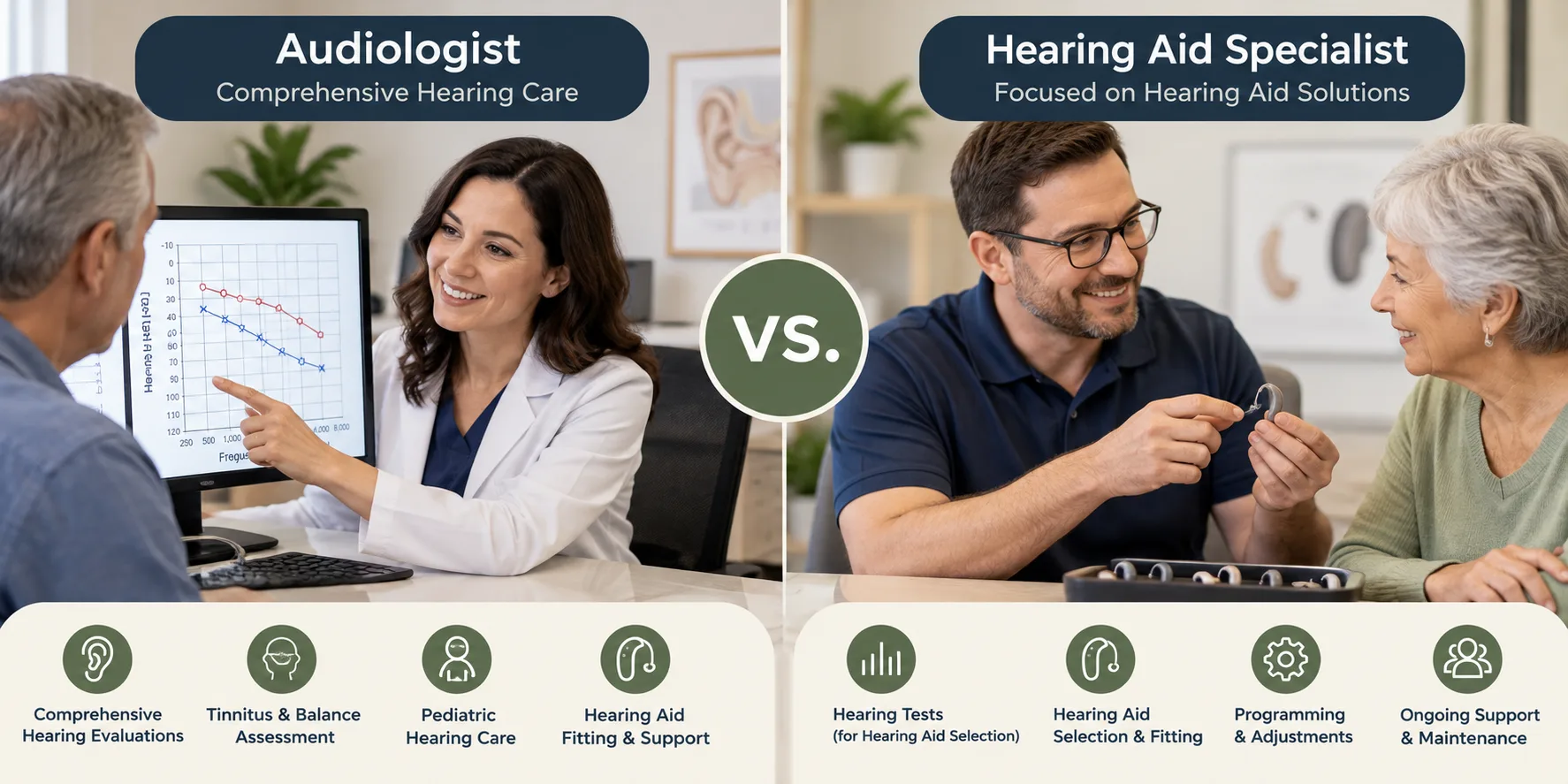
Hearing Aid Specialist vs. Audiologist: The Education Difference
A Hearing Aid Specialist should not be confused with an audiologist.
They are separate occupations with different educational pathways.
BLS says audiologists typically need a Doctor of Audiology, or Au.D., degree to enter the occupation, and all states require audiologists to be licensed. Bureau of Labor Statistics
By comparison, BLS lists a high school diploma or equivalent as the typical entry-level education for Hearing Aid Specialists nationally. Bureau of Labor Statistics
That difference is important for people exploring careers in hearing care. Someone who wants to work in the field but does not want to pursue the doctoral education required for audiology may find the Hearing Aid Specialist pathway worth researching.
Your CMS should internally link Audiologist vs. Hearing Aid Specialist here if that guide is live.
Does Having a Degree Still Help?
Not needing a bachelor's degree everywhere does not mean education has no value.
Formal hearing instrument sciences programs may provide structured education alongside hands-on preparation. In some states, completing a particular academic pathway may be part of qualifying for licensure.
The best choice depends primarily on the requirements of the state where you intend to work.
Before enrolling in a program, verify that the program actually satisfies the licensing requirements for that jurisdiction. IHS specifically recommends contacting the relevant licensing agency before selecting a training pathway. IHS
That is particularly important if you plan to move between states later, because licensing requirements are not necessarily interchangeable.
How Much Do Hearing Aid Specialists Earn?
Education requirements are only one consideration when evaluating the career.
BLS reports a May 2025 median annual wage of $65,160 for Hearing Aid Specialists. The occupation had about 11,200 jobs in 2025, and BLS projects employment to increase to approximately 13,400 by 2035, a growth rate of about 19%. BLS projects roughly 900 openings per year on average over that period. Bureau of Labor Statistics
Those are national occupational statistics. Actual compensation varies by employer, location, experience, licensing status and compensation structure.
Your CMS should internally link Hearing Aid Specialist Salary here if that guide is published.
Can You Start as a Trainee Before Becoming Licensed?
In jurisdictions that allow or require supervised training, prospective specialists may be able to enter the profession in a trainee, apprentice or similar supervised role before becoming fully licensed.
The exact title and rules vary by jurisdiction.
IHS encourages people following the on-the-job pathway to find a qualified trainer or mentor and specifically points prospective specialists toward trainee employment opportunities. IHS
For job seekers, this means it can be useful to search more than just the exact phrase “Hearing Aid Specialist.”
Relevant employers may advertise roles using terms such as Hearing Instrument Specialist, Hearing Aid Dispenser, Hearing Instrument Dispenser, trainee or related titles. O*NET lists several of these as reported titles within the Hearing Aid Specialist occupational classification. O*NET OnLine
This is a natural place for your CMS to internally link to your live jobs page.
So, Can You Become a Hearing Aid Specialist Without a Degree?
Yes, it can be possible — depending on the state.
You do not universally need a bachelor's degree to enter the Hearing Aid Specialist profession. Federal occupational data identify a high school diploma or equivalent as the typical entry-level education, and IHS says most people enter through on-the-job training. Bureau of Labor Statistics
But that should not be interpreted as a universal licensing rule.
Some jurisdictions have additional educational requirements, and the licensing pathway may include supervised training, written or practical examinations and other state-specific requirements.
Before accepting a trainee position or enrolling in a program, verify the current requirements with the licensing authority in the state where you intend to practice.
Frequently Asked Questions
Can I become a Hearing Aid Specialist with only a high school diploma?
Potentially, depending on your state. BLS lists a high school diploma or equivalent as the typical entry-level education nationally, but state licensing requirements may require additional training, examinations or education. Bureau of Labor Statistics
Do I need a four-year degree?
A four-year degree is not a universal requirement for Hearing Aid Specialists. IHS identifies both on-the-job training and academic hearing instrument sciences programs as entry pathways. State licensing rules determine which path qualifies you locally. IHS
Do Hearing Aid Specialists need an Au.D.?
No. An Au.D. is associated with the audiologist career path. BLS says audiologists typically need a Doctor of Audiology degree. Hearing Aid Specialist education requirements are different and vary by state. Bureau of Labor Statistics
Is there one national Hearing Aid Specialist license?
Licensing requirements are jurisdiction-specific. IHS directs prospective specialists to the appropriate state or provincial licensing agency because requirements and processes vary. IHS
Where can I find Hearing Aid Specialist jobs?
Use the live job search on HearingAidSpecialistJobs.com and search related titles such as Hearing Instrument Specialist and Hearing Aid Dispenser as well.
Internal CTA: Browse current Hearing Aid Specialist jobs → /jobs
Sources for the published article
Use these as real outbound hyperlinks in your CMS rather than linking to secondary career blogs: U.S. Bureau of Labor Statistics — Hearing Aid Specialists; BLS — 2025–2035 Occupational Projections; International Hearing Society — How to Become a Hearing Aid Specialist; IHS — International Licensing Examination; O*NET — Hearing Aid Specialists; Florida Board of Hearing Aid Specialists — Licensing Requirements; Washington State Hearing Aid Specialist Rules; BLS — Audiologists.
This article contains career and licensing information only; it does not provide medical advice.