Career Advice
Is Hearing Aid Specialist a Good Career?
Hearing Aid Specialist work combines client care, technology and healthcare-related tasks, with projected job growth and accessible entry paths. State licensing rules and client-facing duties are important considerations.
Is a Hearing Aid Specialist a Good Career?
For the right person, becoming a Hearing Aid Specialist can offer an attractive combination of healthcare-related work, direct client interaction, technical skills and a relatively accessible entry path.
The occupation also has a strong current employment outlook. The U.S. Bureau of Labor Statistics projects employment of Hearing Aid Specialists to increase from about 11,200 jobs in 2025 to 13,400 in 2035, a 19.4% increase. That is substantially faster than the 3.5% projected growth for all U.S. occupations. Bureau of Labor Statistics
But whether it is a “good career” depends on what you want from your work.
Why Hearing Aid Specialist can be a good career
1. The occupation is projected to grow quickly
BLS classifies Hearing Aid Specialist among the faster-growing U.S. occupations.
Employment is projected to grow approximately 19% between 2025 and 2035, adding about 2,200 positions. BLS projects roughly 900 openings per year on average during that period. Bureau of Labor Statistics
That doesn't guarantee an opening in every city, but nationally the outlook is favorable.
2. The typical entry education is not a four-year degree
BLS currently lists a high school diploma or equivalent as the typical entry-level education for Hearing Aid Specialists, with moderate-term on-the-job training. Bureau of Labor Statistics
The International Hearing Society identifies two primary paths into the profession:
on-the-job training
academic education in hearing instrument sciences
IHS says most individuals enter through on-the-job training. IHS
State licensing requirements still control what an individual candidate actually needs.
Related: [Do You Need a Degree to Be a Hearing Aid Specialist?](/career-guides/do-you-need-a-degree-to-be-a-hearing-aid-specialist)
3. Pay is above the national median for many occupations
BLS reports a 2025 median annual wage of $65,160 for Hearing Aid Specialists. Bureau of Labor Statistics
The 2025 Occupational Employment and Wage Statistics data reports a median hourly wage of approximately $31.33. Bureau of Labor Statistics
Actual earnings can vary significantly by location, experience, employer and compensation structure.
Related: [How Much Do Hearing Aid Specialists Make Per Hour?](/career-guides/hearing-aid-specialist-hourly-pay)
4. The work combines people and technology
Hearing Aid Specialists don't simply work with devices.
O*NET lists duties such as:
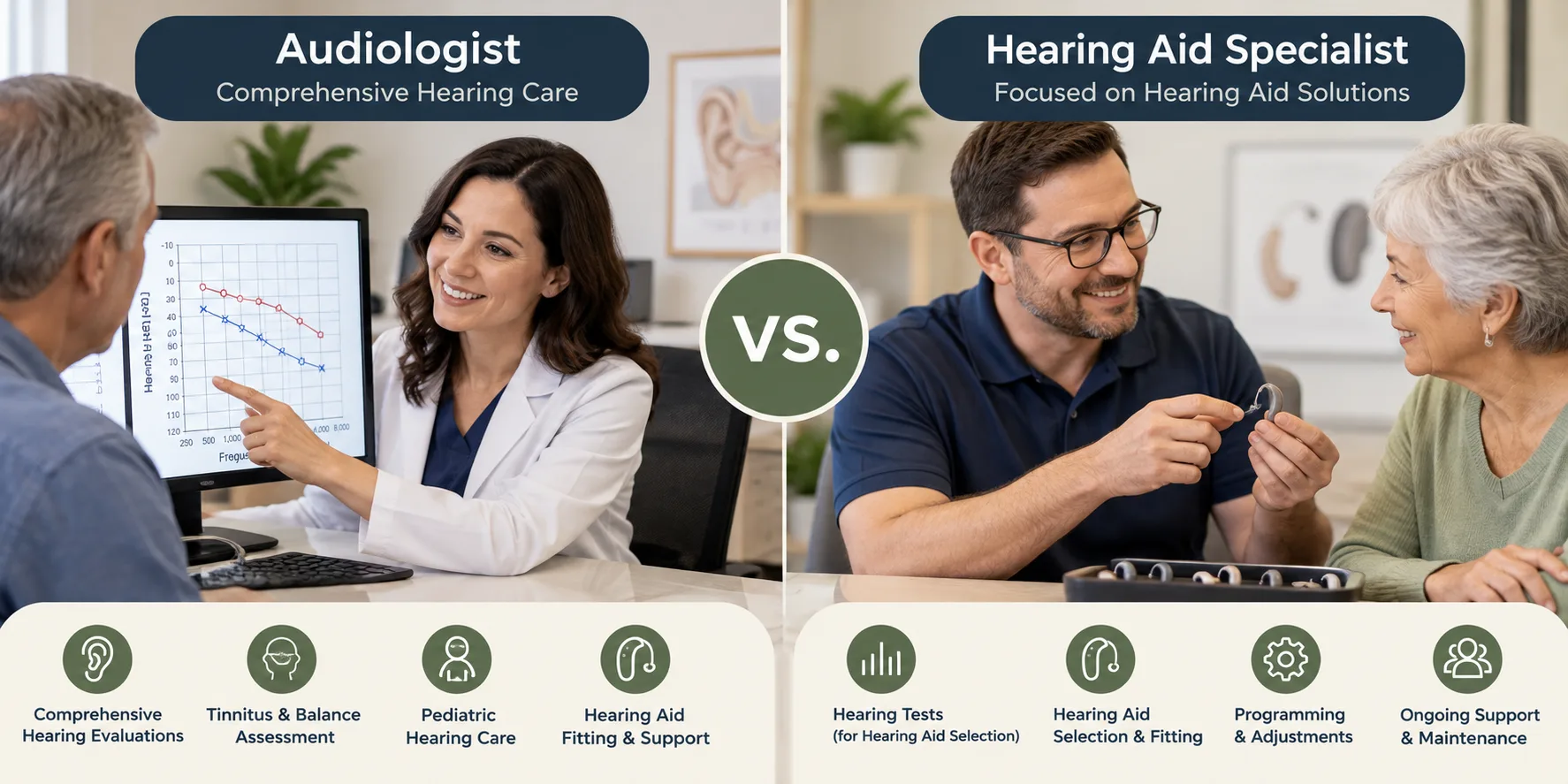
testing hearing
fitting hearing aids
teaching clients how to use hearing devices
counseling clients and families
taking ear impressions
maintaining or repairing hearing instruments
demonstrating assistive listening devices O*NET OnLine
Someone who likes both technology and working directly with people may find that combination appealing.
5. Apprenticeship and workplace-training paths exist
O*NET lists Hearing Aid Specialist as an occupation with an apprenticeship title approved for use in a U.S. Department of Labor Registered Apprenticeship Program. O*NET OnLine
Not every trainee job is a registered apprenticeship, but workplace training is a recognized pathway into the profession.
What are the downsides?
There are also considerations that may make the career less appealing to some people.
Licensing varies by state
There isn't one national Hearing Aid Specialist license.
IHS explains that each jurisdiction establishes its own licensing process, including possible trainee permits, exams, education and scope-of-practice requirements. IHS
Moving between states can therefore require additional licensing steps.
It is very client-facing
This is not a quiet back-office technical position.
O*NET describes the occupation as involving substantial direct interaction with clients, including counseling, instruction and communication. O*NET OnLine
If you strongly dislike customer-facing work, the profession may not be the best fit.
Employers can structure roles differently
One employer may emphasize technical hearing-care responsibilities.
Another may combine hearing care with significant retail, business-development or sales expectations.
Candidates should read each job description carefully instead of assuming every Hearing Aid Specialist position is identical.
Training does not end when you become licensed
Hearing technology, products and professional requirements change.
O*NET includes maintaining current professional knowledge among the occupation's activities. O*NET OnLine
Who may be a good fit?
Hearing Aid Specialist may be worth considering if you enjoy:
working one-on-one with people
learning technology
explaining technical information
hands-on work
customer service
problem-solving
a healthcare-related career without pursuing a doctoral degree
It may be less attractive if you want a career with little client interaction or want to avoid licensing requirements.
Is Hearing Aid Specialist a good career overall?
There isn't a universal answer, but the objective career indicators are encouraging.
The occupation currently offers:
19.4% projected employment growth
$65,160 median annual pay
High school diploma or equivalent as the national typical entry education
Workplace-training and apprenticeship pathways Bureau of Labor Statistics
For someone who enjoys working with people and technology and is comfortable completing state licensing requirements, Hearing Aid Specialist can be a career worth exploring.
[Browse current Hearing Aid Specialist jobs →]
Career information disclaimer: This guide provides general career information. Licensing requirements, job responsibilities and compensation vary by employer and jurisdiction. Verify current licensing requirements with the applicable state authority.