Career Advice
Hearing Aid Specialist Duties, Skills, Training, and Jobs
A Hearing Aid Specialist fits and services hearing aids, conducts hearing tests, teaches clients how to use devices, and works closely with the public in client-facing settings.
What Does a Hearing Aid Specialist Do?
A Hearing Aid Specialist is a hearing-care professional who works with hearing instruments and the people who use them.
According to the U.S. Bureau of Labor Statistics, Hearing Aid Specialists select and fit hearing aids, administer and interpret hearing tests, assess how well hearing instruments are working, and take ear impressions used to prepare or modify earmolds. Bureau of Labor Statistics
The profession combines technical hearing-instrument work with a significant amount of direct interaction with clients.
O*NET reports that dealing with the public is extremely important in this occupation, while active listening and speaking are among its most important skills. O*NET OnLine
For someone interested in hearing care but not necessarily pursuing the doctoral education required to become an audiologist, Hearing Aid Specialist can provide another path into the field.
What are the main duties of a Hearing Aid Specialist?
A Hearing Aid Specialist's responsibilities can vary by employer and by state scope-of-practice rules.
However, O*NET identifies several common duties.
Conduct hearing tests
Hearing Aid Specialists may administer basic hearing tests, including air-conduction, bone-conduction and speech audiometry tests. O*NET also identifies several basic hearing-screening procedures among the occupation's tasks. O*NET OnLine
The exact services a licensed specialist is permitted to perform depend on applicable state law and licensing requirements.
Select and fit hearing aids
One of the core functions of the occupation is helping select and fit hearing instruments.
BLS summarizes the occupation as professionals who select and fit hearing aids and assess hearing-instrument performance. Bureau of Labor Statistics
The work can therefore involve both technical knowledge of hearing devices and communication with the person who will use them.
Teach clients how to use hearing aids
Providing a hearing aid is only part of the job.
O*NET lists training clients to use hearing aids and other communication devices as one of the occupation's core tasks. O*NET OnLine
That can make teaching and communication skills particularly useful in this career.
Counsel clients and families
O*NET also identifies counseling patients and families about communication strategies and the effects of hearing loss as a core task. O*NET OnLine
This means the occupation isn't purely technical.
A specialist may spend a significant part of the workday explaining information, answering questions and helping clients understand how to use hearing technology in daily life.
Take ear impressions
Hearing Aid Specialists may take impressions used to make or modify earmolds and hearing-aid shells.
Both BLS and O*NET specifically include ear impressions and earmold-related work within the occupation. Bureau of Labor Statistics
Maintain and repair hearing aids
Hearing instruments may also require maintenance, adjustment or repair.
O*NET identifies maintaining or repairing hearing aids and other communication devices as a core duty. O*NET OnLine
Demonstrate assistive listening technology
The role can extend beyond traditional hearing aids.
O*NET includes demonstrating assistive listening devices to clients among the occupation's tasks. O*NET OnLine
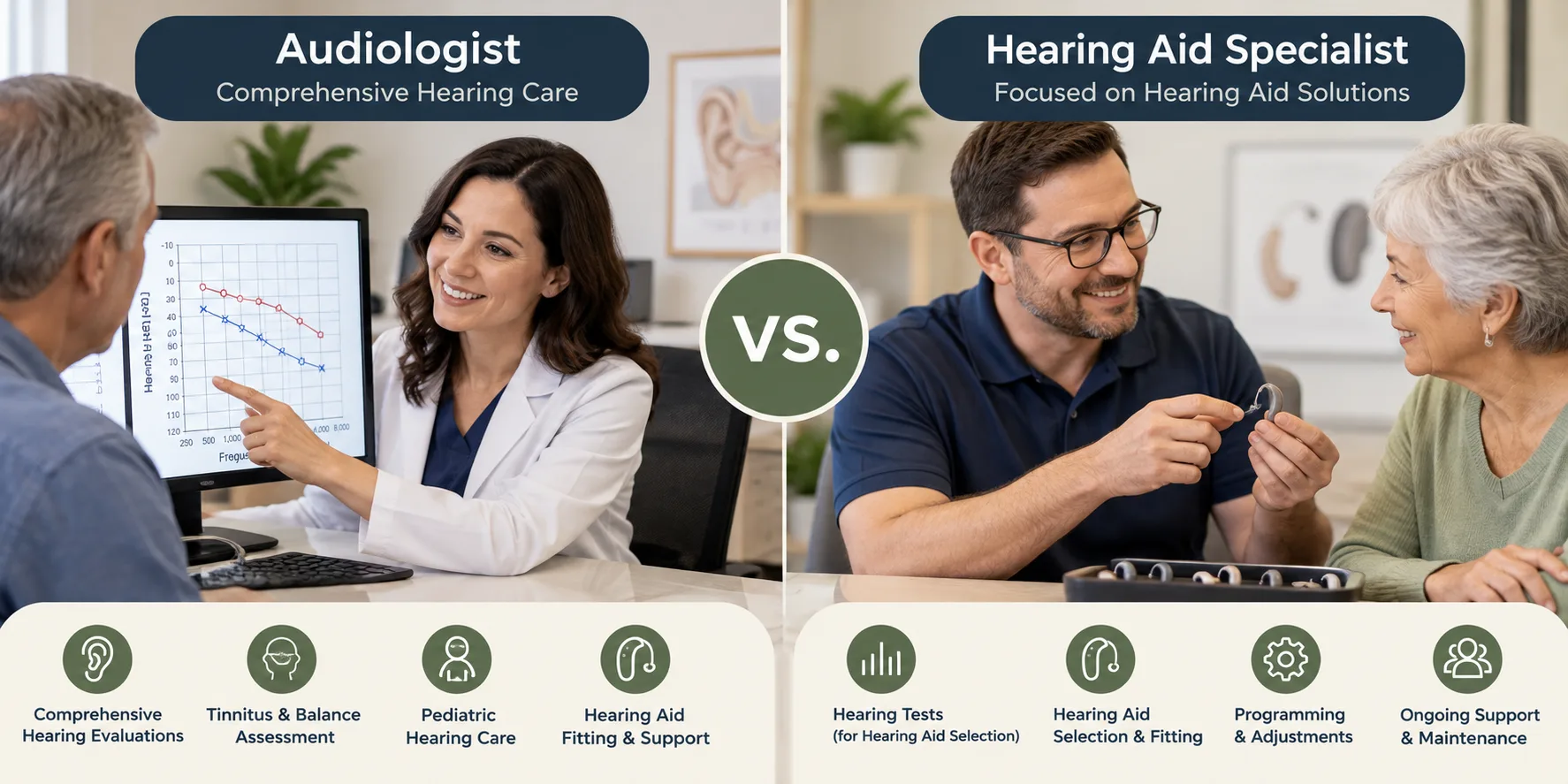
Is a Hearing Aid Specialist the same as an audiologist?
No.
BLS treats Hearing Aid Specialist and Audiologist as separate occupations. Its Hearing Aid Specialist occupational definition specifically excludes audiologists. Bureau of Labor Statistics
The education pathways are also very different.
For Hearing Aid Specialists, BLS currently lists a high school diploma or equivalent as the typical entry-level education nationally and moderate-term on-the-job training as the typical training category. Bureau of Labor Statistics
Audiologists follow a substantially longer professional education path.
State licensing rules still determine what education, supervised training, permits and examinations a Hearing Aid Specialist needs before practicing.
Related:
[Hearing Aid Specialist vs. Audiologist](/career-guides/hearing-aid-specialist-vs-audiologist)
Is a Hearing Aid Specialist the same as a Hearing Instrument Specialist?
The terminology often overlaps.
O*NET lists reported job titles for this occupational category including:
Hearing Aid Specialist
Hearing Instrument Specialist
Hearing Instrument Dispenser
Hearing Care Specialist
Hearing Care Practitioner
Licensed Hearing Instrument Specialist O*NET OnLine
The title used by an employer or licensing authority can vary, so job seekers should search more than one title.
On HearingAidSpecialistJobs.com, that is why it makes sense to browse opportunities across Hearing Aid Specialist, Hearing Instrument Specialist and Hearing Aid Dispenser roles.
What skills does a Hearing Aid Specialist need?
The occupation combines technical, interpersonal and customer-facing skills.
O*NET identifies active listening as the highest-rated essential skill for Hearing Aid Specialists. Speaking, reading comprehension, active learning and critical thinking also appear among the important skills. O*NET OnLine
That suggests successful specialists need more than product knowledge.
Active listening
A specialist needs to understand a client's concerns and communication needs.
Because this profession involves substantial direct interaction with clients, being able to listen carefully can be particularly important.
Communication
Hearing Aid Specialists routinely explain devices, demonstrate their use and answer questions.
O*NET identifies speaking as an important skill and also lists instructing and service orientation among relevant transferable skills. O*NET OnLine
Technical learning
Hearing technology changes over time.
O*NET includes maintaining current professional knowledge as part of the occupation and specifically identifies reading current literature, communicating with colleagues and participating in professional organizations or conferences. O*NET OnLine
Customer service
This is a highly client-facing occupation.
O*NET reports that 90% of respondents considered dealing with external customers or the public extremely important for Hearing Aid Specialists. O*NET OnLine
Candidates who enjoy both technical work and working directly with people may therefore find the occupation especially appealing.
What software and technology do Hearing Aid Specialists use?
The work increasingly involves computers and specialized hearing-care software.
O*NET lists technologies associated with the occupation including:
HIMSA NOAH
Otometrics OTOsuite
Microsoft Outlook
Microsoft Office
spreadsheets
word-processing software O*NET OnLine
Individual employers may use different systems.
Job seekers should therefore treat software familiarity as a potentially useful skill rather than assuming every workplace uses the same products.
Where do Hearing Aid Specialists work?
Hearing Aid Specialists can work in environments that provide hearing-care services or sell and fit hearing instruments.
Depending on the employer, that may include:
independent hearing-care practices
multi-location hearing centers
hearing-aid retail organizations
medical or audiology practices
large retail hearing centers
The work is generally highly client-facing.
O*NET reports constant or frequent interaction with other people and describes working directly with the public as an important part of the occupation. O*NET OnLine
Do you need a degree to become a Hearing Aid Specialist?
A four-year degree is not the national typical entry requirement.
Current BLS data lists:
Typical entry-level education: High school diploma or equivalent
Typical related work experience: None
Typical on-the-job training: Moderate-term on-the-job training Bureau of Labor Statistics
That does not mean every state allows someone to begin practicing with only a high school diploma.
Licensing requirements can include supervised training, examinations, permits or specific education.
The International Hearing Society recommends first contacting the licensing agency in the jurisdiction where you plan to practice. IHS identifies two primary training pathways: on-the-job training and academic study in hearing instrument sciences, and says most entrants use the on-the-job route. IHS
Related:
[Can You Become a Hearing Aid Specialist Without a Degree?](/career-guides/can-you-become-a-hearing-aid-specialist-without-a-degree)
Can you train on the job?
Yes, and it is an important pathway into the profession.
IHS says most people entering the field use on-the-job training and recommends finding a trainer or mentor when pursuing that route. IHS
O*NET also lists Hearing Aid Specialist as an occupation with an apprenticeship title approved for use in a U.S. Department of Labor Registered Apprenticeship Program. O*NET OnLine
However, not every trainee position is a formal registered apprenticeship.
Related:
[Hearing Aid Specialist Apprenticeship & Trainee Jobs Guide](/career-guides/hearing-aid-specialist-apprenticeship-trainee-jobs)
How much do Hearing Aid Specialists make?
According to the latest BLS occupational projections data, the May 2025 median annual wage was $65,160 for Hearing Aid Specialists. Bureau of Labor Statistics
Actual compensation can vary based on factors such as:
location
experience
employer
compensation structure
commissions or bonuses
licensing status
A national median should therefore not be treated as a guaranteed starting salary.
Related:
[Hearing Aid Specialist Salary Guide](/career-guides/hearing-aid-specialist-salary)
Is Hearing Aid Specialist a growing career?
Current BLS projections are strong.
BLS estimates approximately 11,200 Hearing Aid Specialist jobs in 2025 and projects about 13,400 by 2035.
That represents projected employment growth of 19.4%, or approximately 2,200 additional jobs. BLS categorizes the occupation among the faster-growing U.S. occupations. Bureau of Labor Statistics
BLS also projects approximately 900 openings per year on average over the 2025–2035 period. Bureau of Labor Statistics
These are national projections rather than guarantees about hiring in a particular location.
Who might enjoy this career?
Hearing Aid Specialist may appeal to someone who likes a combination of:
Working with people
The profession involves frequent direct client interaction.
Technology
Hearing instruments, testing equipment and specialized software are central to the work.
Hands-on work
Fitting devices, testing hearing instruments and working with earmolds involve practical skills.
Teaching
Helping clients learn to use hearing devices is a core responsibility.
Healthcare-related work without a doctoral career path
Nationally, the typical entry education reported by BLS is substantially different from that required for audiology. O*NET OnLine
How do you become a Hearing Aid Specialist?
A typical starting process is:
Check the licensing requirements in your state.
Determine whether a trainee or apprentice permit is required.
Find an employer, trainer or appropriate educational program.
Complete the required education or supervised training.
Complete required licensing examinations.
Apply for the appropriate state license.
Begin searching for licensed Hearing Aid Specialist positions.
IHS specifically recommends contacting the applicable licensing agency first because requirements vary by jurisdiction. IHS
Related:
[How Long Does It Take to Become a Hearing Aid Specialist?](/career-guides/how-long-does-it-take-to-become-a-hearing-aid-specialist)
Find Hearing Aid Specialist jobs
If this career sounds like a fit, explore current openings across the United States.
[Browse Hearing Aid Specialist Jobs →](/jobs)
Also search related job titles such as:
Hearing Instrument Specialist
Hearing Aid Dispenser
Hearing Care Specialist
Hearing Aid Specialist Trainee
Hearing Instrument Specialist Trainee
Using multiple related titles can help you find opportunities that would otherwise be missed.
Sources & References
Primary sources used for this guide:
U.S. Bureau of Labor Statistics — Hearing Aid Specialists
Current occupational wage, employment, education and projection data. Bureau of Labor Statistics
O*NET OnLine — Hearing Aid Specialists (29-2092.00)
Occupational duties, skills, work context, technology and apprenticeship information. O*NET OnLine
International Hearing Society — How to Become a Hearing Aid Specialist
Training-pathway and licensing guidance. IHS
Hearing care also overlaps with broader communication and wellness topics. For additional health and communication resources, visit Healthy Voices.
Career information disclaimer: This guide provides general career and licensing information. Licensing requirements and permitted duties vary by jurisdiction and can change. Verify current requirements with the appropriate licensing authority where you intend to work.