Salary & Compensation
Hearing Aid Instrument Specialist Salary: 2026 Pay Guide
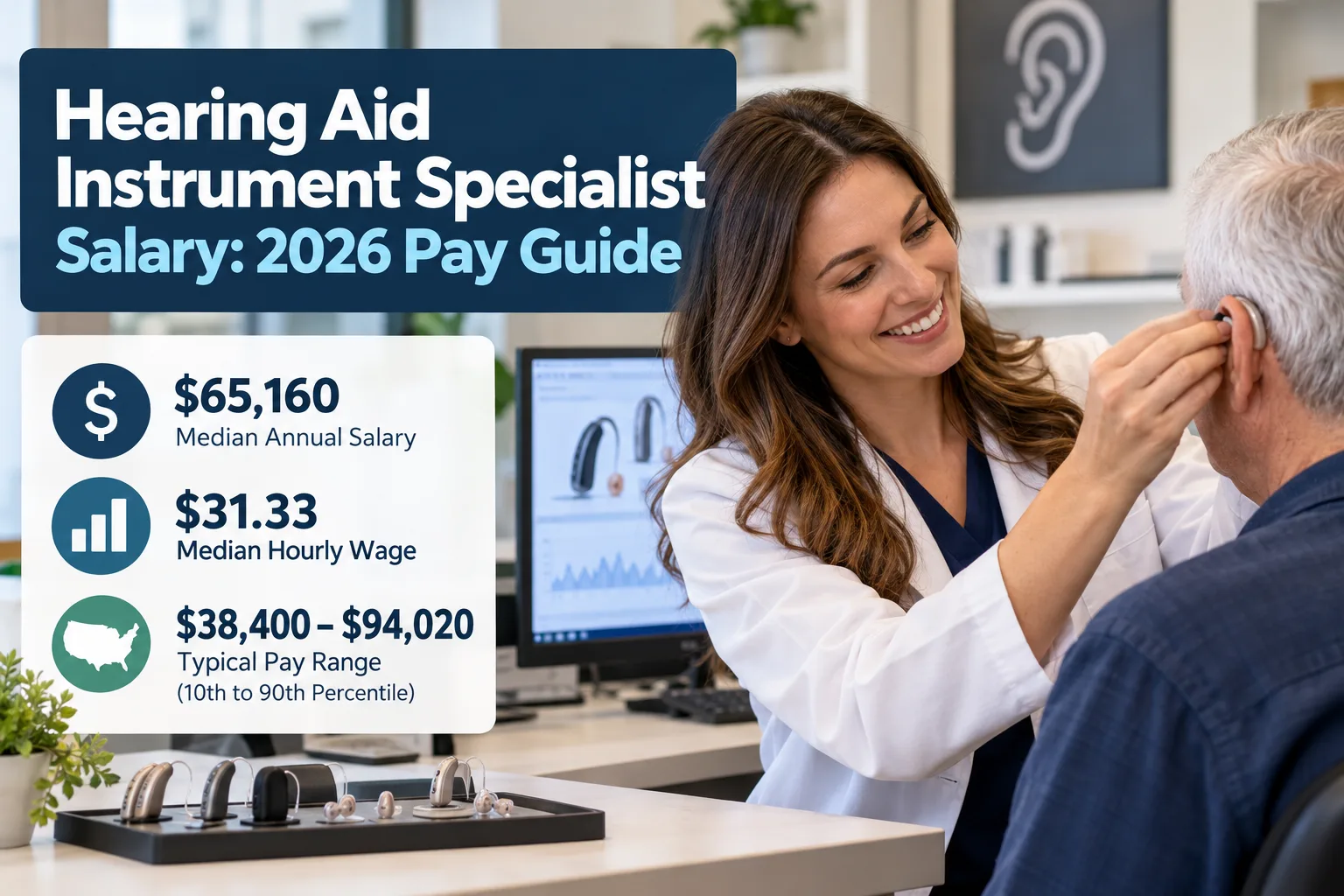
Hearing Aid Instrument Specialist Salary: 2026 Pay Guide . Hearing Instrument Specialist pay is benchmarked by BLS data, with a national median of $65,160 per year and $31.33 per hour. Earnings vary by location, experience, licensing, and commission structure.
Hearing Aid Instrument Specialist Salary: 2026 Pay, Hourly Wage & Commission Guide
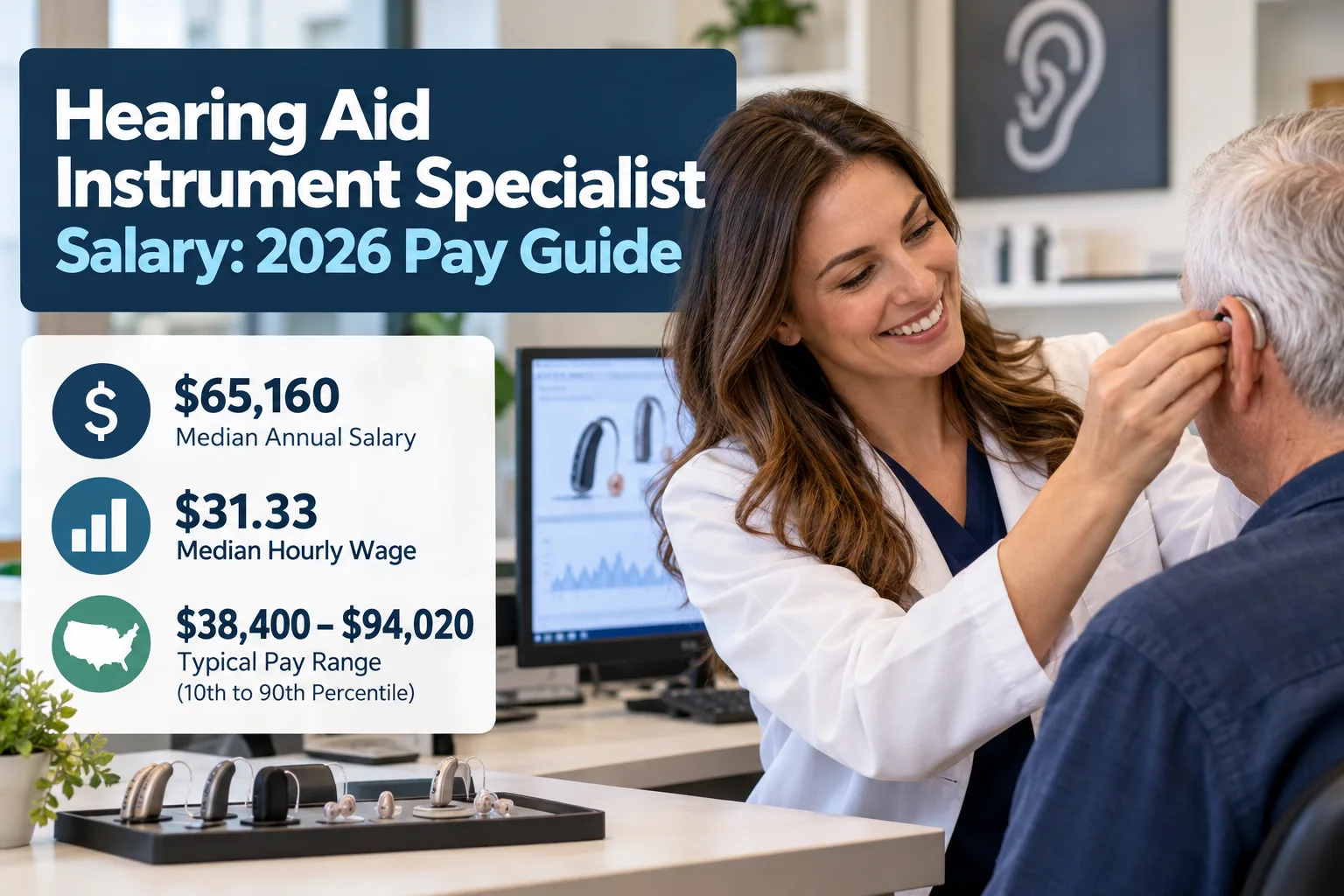
How much does a hearing aid instrument specialist make? According to the latest available U.S. Bureau of Labor Statistics wage data, the median salary for Hearing Aid Specialists is $65,160 per year, or $31.33 per hour.
Pay can vary considerably, however. The latest national wage data show earnings ranging from about $38,400 at the 10th percentile to $94,020 at the 90th percentile. Location, experience, licensing, employer, and incentive compensation can all affect what an individual Hearing Instrument Specialist earns.
If you are comparing salary with real openings, browse current opportunities on Hearing Instrument Specialist Jobs or search the full Hearing Aid Specialist Jobs career network.
Hearing Aid Instrument Specialist Salary at a Glance
Based on May 2025 Bureau of Labor Statistics wage data, the national pay distribution for Hearing Aid Specialists is:
Pay Level | Annual Wage | Hourly Wage |
|---|---|---|
10th percentile | $38,400 | $18.46 |
25th percentile | $48,390 | $23.27 |
Median | $65,160 | $31.33 |
75th percentile | $80,010 | $38.47 |
90th percentile | $94,020 | $45.20 |
These figures come from BLS wage data reported through O*NET.
BLS separately reports a mean annual wage of $66,370, or $31.91 per hour, for Hearing Aid Specialists in its May 2025 national Occupational Employment and Wage Statistics results.
The difference is important: median pay and average pay are not the same measurement. The median of $65,160 represents the midpoint of the wage distribution, while $66,370 is the arithmetic mean.
Is a Hearing Instrument Specialist the Same as a Hearing Aid Specialist?
For federal occupational wage data, they are treated as titles within the same occupational category.
O*NET classifies the occupation under 29-2092.00 — Hearing Aid Specialists and lists several reported job titles, including:
Hearing Aid Specialist
Hearing Instrument Specialist (HIS)
Licensed Hearing Instrument Specialist
Hearing Instrument Dispenser
Hearing Care Specialist
Hearing Care Practitioner
That means someone searching for “hearing aid instrument specialist salary,” “hearing instrument specialist salary,” or “HIS salary” will generally find the most reliable federal wage information under the Hearing Aid Specialist classification.
You can also see how employers currently use these titles by browsing Hearing Instrument Specialist job openings.
How Much Do Hearing Instrument Specialists Make Per Hour?
The latest national median is $31.33 per hour.
The BLS-based wage distribution ranges from:
$18.46 per hour at the 10th percentile
to
$45.20 per hour at the 90th percentile.
These are national figures. Actual compensation can be higher or lower depending on the local labor market and the compensation structure offered by an employer.
For example, a Hearing Instrument Specialist may receive:
A fixed salary
An hourly wage
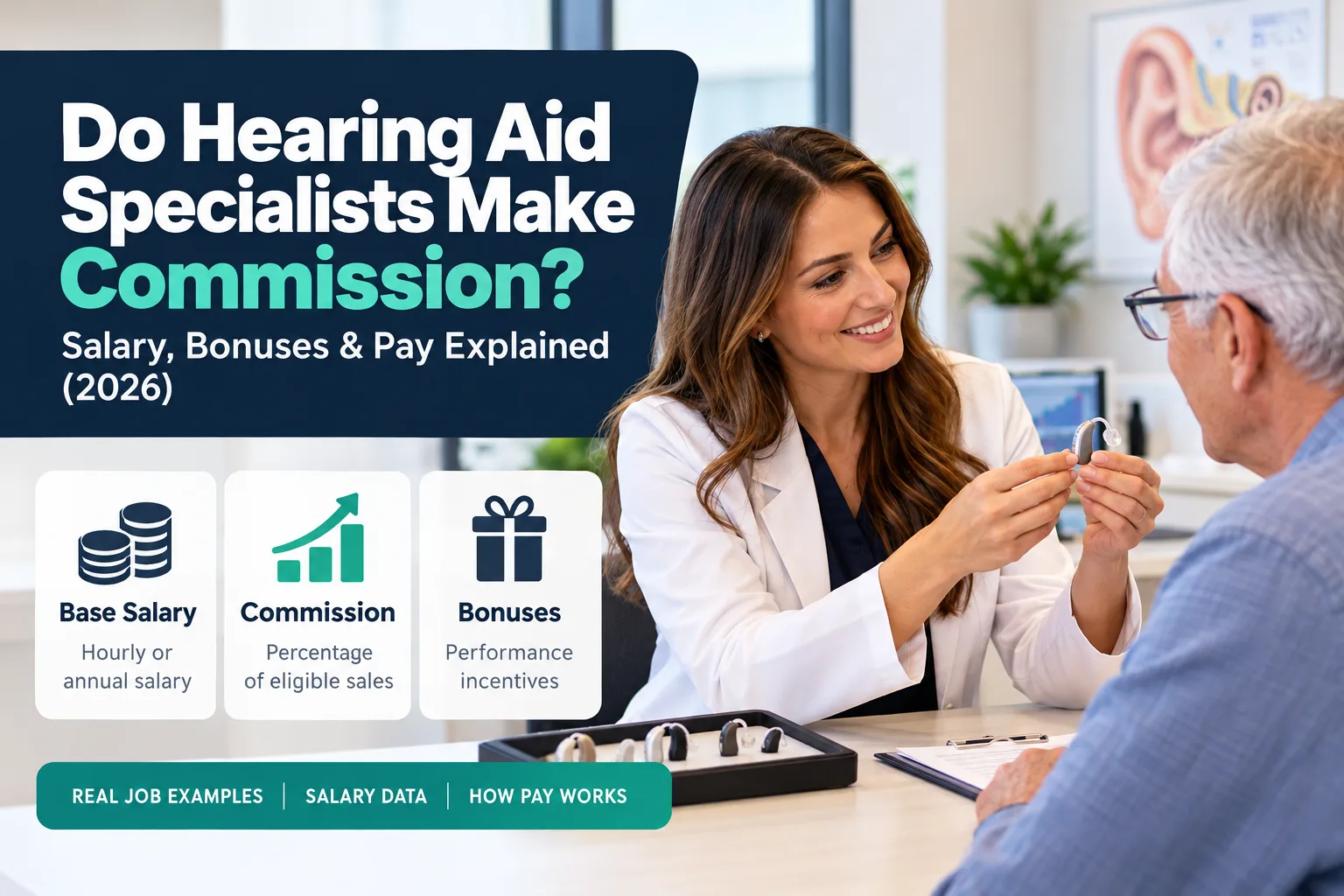
Base salary plus commission
Salary plus performance incentives
Sign-on or relocation incentives
Other employer-specific compensation
For a deeper breakdown of how salary and incentive plans can work in this field, read our Hearing Aid Specialist Commission and Salary Guide.
Does the BLS Salary Include Commission?
This is an important detail when comparing Hearing Instrument Specialist compensation.
The Bureau of Labor Statistics says its Occupational Employment and Wage Statistics wage measure includes base pay and incentive compensation such as commissions and production bonuses.
It excludes certain types of compensation, including overtime, severance pay, shift differentials and nonproduction bonuses.
Therefore, the $65,160 median should not automatically be interpreted as base salary alone.
That matters in hearing care because many current job listings advertise a base salary plus additional commission or incentive compensation.
Current Hearing Instrument Specialist Salary Examples
Salary surveys show the broad national picture. Current job advertisements can help show what employers are actually advertising for individual positions.
As of October 26, 2026, examples appearing on HearingAidSpecialistJobs.com included:
Starkey — Ames, Iowa: Audiologist or Hearing Instrument Specialist advertised at $60,000–$68,000.
AudioNova — Ann Arbor, Michigan: Audiologist / Hearing Instrument Specialist advertised at $65,000–$75,000 plus commission.
HearingLife — Wautoma, Wisconsin: Audiologist or Hearing Instrument Specialist advertised at $70,000–$90,000 plus 6% uncapped commission, with relocation/sign-on compensation also listed.
Innovative Hearing — Buffalo, New York: Dispensing Audiologist/Hearing Instrument Specialist advertised at $75,000–$125,000 per year.
HearingLife — San Antonio, Texas: Hearing Instrument Specialist advertised with a $65,000–$90,000 base salary plus uncapped commission.
These are individual job advertisements, not national salary averages, and job listings can change or expire. They nevertheless illustrate why total compensation for a Hearing Instrument Specialist may differ significantly from one employer or market to another.
See the newest listings on our Hearing Instrument Specialist Jobs page.
Hearing Aid Instrument Specialist Salary by State
Location can have a significant effect on earnings.
Here are several examples using 2025 BLS wage data reported through O*NET:
State | Median Annual Wage | Median Hourly Wage |
|---|---|---|
New York | $82,990 | $39.90 |
California | $80,060 | $38.49 |
New Jersey | $75,720 | $36.41 |
Texas | $59,140 | $28.43 |
United States | $65,160 | $31.33 |
These figures demonstrate why a national salary number should be viewed as a benchmark rather than a guaranteed salary.
A job in California, New York, New Jersey or another higher-paying market may have a different compensation range than a similar position elsewhere.
Candidates can compare openings by location through our national hearing-care jobs search.
You can also browse specific markets including New York hearing-care jobs and Texas hearing-care jobs.
What Affects a Hearing Instrument Specialist's Salary?
There is no single salary that applies to every Hearing Instrument Specialist.
Location
BLS wage data show substantial differences among states and metropolitan areas.
For example, the 2025 median for Hearing Aid Specialists was $82,990 in New York, compared with $59,140 in Texas.
Experience
Individual employers may pay differently based on experience and credentials.
Current advertisements on HearingAidSpecialistJobs.com include positions requiring several years of dispensing experience as well as positions with different compensation ranges based on license type or credentials.
Commission Structure
Some positions advertise a salary alone, while others advertise salary plus commission or incentive compensation.
For that reason, two jobs with similar base salaries may have different potential total compensation.
Licensing and Credentials
Requirements for dispensing hearing instruments vary by jurisdiction and employer. Candidates should review the licensing requirements stated in each job advertisement and the applicable state licensing authority.
If you are considering entering the profession, see Can You Become a Hearing Aid Specialist Without a Degree?.
Can a Hearing Instrument Specialist Make $100,000 a Year?
It is possible for individual positions to advertise compensation at or above $100,000, but this should not be presented as typical national pay.
The national 90th-percentile BLS wage is $94,020.
However, current job advertisements show that some positions advertise compensation above that amount. For example, the Buffalo position cited above listed $75,000–$125,000 per year.
Compensation above the national wage distribution may be associated with factors such as experience, geography, employer compensation structure or incentive pay.
Candidates should compare base salary, expected commission, benefits and other incentives separately rather than assuming a high advertised total represents guaranteed base pay.
What Is the Job Outlook for Hearing Instrument Specialists?
The salary data are accompanied by a strong employment outlook.
The Bureau of Labor Statistics projects employment for Hearing Aid Specialists to increase from approximately 11,200 jobs in 2025 to 13,400 jobs in 2035.
That represents approximately 19% employment growth, or about 2,200 additional jobs, over the decade. BLS also projects roughly 900 openings per year on average during the 2025–2035 period.
BLS classifies that projected growth as much faster than average.
If you are weighing salary against training requirements and future demand, see our complete guide: Is Becoming a Hearing Aid Specialist Worth It?.
Do You Need a College Degree to Earn a Hearing Instrument Specialist Salary?
BLS lists the typical entry-level education for Hearing Aid Specialists as a high school diploma or equivalent, together with moderate-term on-the-job training.
That does not mean every state or employer has identical requirements. Licensing and training requirements can vary.
The profession is therefore notably different from audiology, which is classified as a separate occupation.
Anyone considering this career should investigate the specific licensing pathway in the state where they intend to work.
Hearing Aid Instrument Specialist Salary FAQ
What is the average Hearing Instrument Specialist salary?
The latest BLS data report a mean wage of $66,370 per year, while the national median is $65,160 per year.
How much does a Hearing Instrument Specialist make per hour?
The national median is $31.33 per hour, according to 2025 BLS wage data.
What do the highest-paid Hearing Instrument Specialists make?
The national 90th-percentile wage is $94,020 per year, although individual job advertisements may offer compensation above that level.
Do Hearing Instrument Specialists earn commission?
Some positions do. Current job advertisements include both salary-only structures and base salary plus commission or incentive plans. BLS also includes commissions and production bonuses in its OEWS definition of wages.
Is Hearing Instrument Specialist the same occupation as Hearing Aid Specialist?
For federal occupational data, Hearing Instrument Specialist (HIS) is listed by O*NET as one of the reported job titles within the Hearing Aid Specialists, SOC 29-2092.00 occupation.
Find Hearing Instrument Specialist Jobs
Salary data are useful for establishing a benchmark, but the best way to understand current compensation is to compare real openings in the locations where you want to work.
Search current Hearing Instrument Specialist Jobs, browse all Hearing Aid Specialist Jobs, or visit HearingAidSpecialistJobs.com to explore opportunities nationwide.
Sources
U.S. Bureau of Labor Statistics — Occupational Outlook Handbook, Data for Occupations Not Covered in Detail. May 2025 median wage, employment, education and 2025–2035 projections.
U.S. Bureau of Labor Statistics — Occupational Employment and Wage Statistics, May 2025. National employment, mean hourly wage and mean annual wage.
O*NET OnLine — Hearing Aid Specialists, 29-2092.00. Occupational titles, responsibilities, national wages and employment information based on U.S. Department of Labor/BLS data.
O*NET OnLine — National Wages for Hearing Aid Specialists. 2025 national percentile wage information based on BLS data.
U.S. Bureau of Labor Statistics — OEWS Technical Notes. Definition of wages and treatment of commissions and incentive compensation.
O*NET OnLine — State Wage Data. New York, California, New Jersey and Texas Hearing Aid Specialist wage estimates based on BLS 2025 data.
HearingAidSpecialistJobs.com — Current Hearing Instrument Specialist Jobs. Examples of advertised compensation reviewed October 26, 2026.