Hearing Aid Specialist
How to Get a Job as a Hearing Aid Specialist
Learn how to get a job as a hearing aid specialist in 2026. Find trainee jobs, understand licensing, prepare your resume, and discover hiring employers.
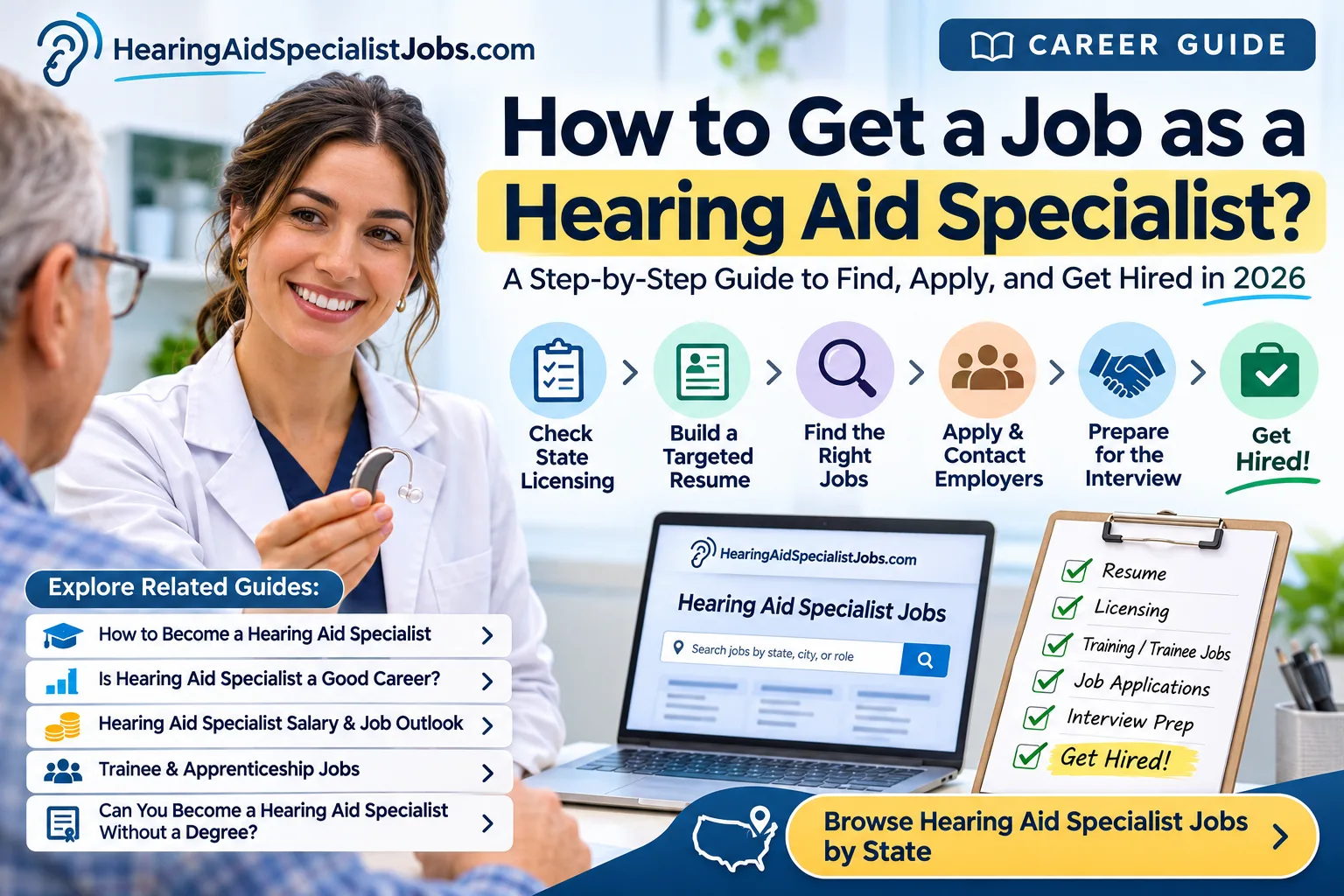
How to Get a Job as a Hearing Aid Specialist in 2026: A Step-by-Step Guide
How do you get a job as a hearing aid specialist? Start by checking your state's licensing requirements, then search for hearing aid specialist, hearing instrument specialist, and hearing aid dispenser jobs. If you have no experience, look for trainee or apprenticeship positions that provide supervised training. If you're already licensed, focus on employers seeking qualified hearing-care professionals.
You do not necessarily need a four-year college degree to enter this profession. According to the International Hearing Society (IHS), many hearing aid specialists begin through on-the-job training under qualified professionals.
Whether you're changing careers, looking for your first healthcare job, or already working in hearing care, this guide explains how to find job opportunities, prepare your resume, approach employers, and improve your chances of getting hired.
You can begin by browsing Hearing Aid Specialist Jobs on HearingAidSpecialistJobs.com, a dedicated U.S. career network for hearing healthcare professionals.
How to Get a Job as a Hearing Aid Specialist: Quick Overview
The best route depends on your current qualifications.
Your situation | Recommended next step |
|---|---|
No hearing healthcare experience | Search for trainee or apprentice positions |
Retail, sales, or customer-service background | Target employers offering supervised training |
Currently completing hearing aid specialist training | Look for positions matching your permit and training status |
Already licensed | Apply for licensed hearing aid specialist and dispenser jobs |
Licensed in another state | Check the new state's licensing and endorsement requirements |
Audiology professional | Search for jobs matching your audiology credentials |
The most important step is matching your qualifications to the right job opening. A fully licensed position and a supervised trainee position can have very different requirements.
If you're still deciding whether to enter this profession, read Is Hearing Aid Specialist a Good Career?.
Step 1: Understand What Employers Look for in a Hearing Aid Specialist
Before applying, understand what the job actually involves.
Hearing aid specialists help people select, fit, use, and maintain hearing instruments. According to O*NET, responsibilities in the occupation include administering hearing tests, evaluating hearing instruments, preparing earmolds, and training clients to use hearing devices.
Depending on the employer and applicable scope-of-practice rules, a position may involve:
Conducting hearing assessments for hearing aid selection and fitting
Explaining hearing aid features and available technology
Programming and adjusting hearing instruments
Troubleshooting device problems
Educating patients about device use and maintenance
Providing follow-up services
Maintaining accurate records
Discussing costs and purchase options
Supporting clinic operations and patient relationships
Employers may also evaluate candidates for communication skills, technical aptitude, professionalism, and the ability to explain complex information clearly.
Some positions include sales or business-development responsibilities. Others emphasize particular technical or patient-care functions.
For a deeper understanding of the occupation, read Hearing Aid Specialist Duties, Skills, Training, and Jobs.
What skills help you get hired?
Useful skills include customer service, listening, problem-solving, basic computer proficiency, attention to detail, and comfort working with technology.
Previous experience in retail, healthcare support, technical support, or consultative sales may be relevant to certain employers.
However, transferable experience does not replace mandatory training, professional credentials, or licensing.
Step 2: Check Hearing Aid Specialist Licensing Requirements in Your State
One of the biggest mistakes applicants can make is applying without understanding licensing requirements.
Hearing aid dispensing is regulated at the state level. There is no single nationwide license that automatically qualifies someone to practice in every state.
Depending on the jurisdiction, requirements may include:
A minimum education requirement
A trainee or apprentice permit
Supervised practical training
Written licensing examinations
Practical examinations
Application fees and other eligibility requirements
The International Hearing Society recommends contacting your local licensing authority before starting training.
You can find licensing contacts through the International Hearing Society Licensing Agency Directory.
Do you need to pass the ILE exam before getting hired?
Not always.
Some employers recruit individuals into supervised trainee roles before they have completed all requirements for full licensure.
Other employers specifically require a currently licensed professional.
The International Licensing Examination for Hearing Healthcare Professionals (ILE) is used by many licensing agencies, but the exact examinations and eligibility requirements depend on the jurisdiction.
For more information, review our Hearing Aid Specialist ILE Licensing Exam Guide.
If you're new to the field, our How to Become a Hearing Aid Specialist in 2026 guide explains the broader licensing and training process.
Step 3: Look for Hearing Aid Specialist Jobs With No Experience
Can you get a hearing aid specialist job without experience? Yes, some employers offer supervised trainee or apprenticeship opportunities to candidates entering the profession, subject to state licensing rules.
According to the International Hearing Society, on-the-job training is a common pathway into hearing aid dispensing.
Under a practice-based training model, a trainee works with a qualified professional while developing the necessary technical and practical skills.
This is especially relevant if you're changing careers and do not already hold a hearing-care license.
Search for trainee and apprenticeship job titles
Instead of searching only for "hearing aid specialist," try these related terms:
Hearing Aid Specialist Trainee
Hearing Instrument Specialist Trainee
Hearing Aid Dispenser Apprentice
Hearing Instrument Specialist Apprentice
Hearing Aid Specialist in Training
Hearing Aid Dispenser Trainee
Hearing Care Trainee
Not all employers use the same terminology, and not every job under a related title is an entry-level position.
Read the qualifications carefully to determine whether the employer offers training or requires an existing license.
Our detailed guide to Hearing Aid Specialist Apprenticeships and Trainee Jobs explains how these opportunities work and what prospective trainees should investigate.
Can you become a hearing aid specialist without a degree?
A four-year college degree is not universally required.
The Bureau of Labor Statistics identifies a high school diploma or equivalent as the typical entry-level education for hearing aid specialists, with moderate-term on-the-job training.
Individual states can establish additional requirements.
For more information, see Can You Become a Hearing Aid Specialist Without a Degree?.
Step 4: Search for Jobs Under Multiple Hearing Healthcare Titles
One practical way to expand your job search is to look beyond a single professional title.
Employers and licensing authorities may use different terminology for closely related hearing aid dispensing occupations.
Three useful job searches are:
Hearing Aid Specialist Jobs
Browse Hearing Aid Specialist Jobs to explore opportunities focused on hearing assessments, hearing instrument fitting, client education, and related services.
Some positions are intended for experienced, licensed professionals. Others may allow candidates entering a supervised training pathway.
Hearing Instrument Specialist Jobs
Explore Hearing Instrument Specialist Jobs to find related dispensing and hearing-care positions.
Hearing instrument specialist is a common professional title used in the industry. Specific licensing terminology varies by state.
Hearing Aid Dispenser Jobs
Find Hearing Aid Dispenser Jobs to identify additional opportunities.
Some state licensing authorities and employers use the term hearing aid dispenser rather than hearing aid specialist.
Searching all three titles can help you discover relevant positions that might otherwise be missed.
Important: Audiologist is a separate profession with different educational and licensing requirements. Do not assume you qualify for an audiologist-only position based on hearing aid specialist training.
Read our guide comparing Hearing Aid Specialist vs. Hearing Instrument Specialist vs. Audiologist.
Step 5: Find Employers Hiring Hearing Aid Specialists
There are several ways to identify potential employers.
Search a hearing-care-specific job board
A specialized job board can help you focus on relevant opportunities without filtering through unrelated positions.
At HearingAidSpecialistJobs.com, candidates can explore hearing healthcare opportunities across the United States.
Start by browsing all hearing-care job openings, then narrow your search by role, employer, or location.
Search hearing aid specialist jobs by state
Location matters because licensing requirements, available positions, and advertised compensation may differ.
Use our Hearing Care Jobs by State Directory to explore opportunities across the country.
Popular state searches include:
These are location-specific job pages, not claims that a particular state is the easiest place to get hired.
You can also search hearing-care jobs by city to focus on local employment opportunities.
Research employers directly
Hearing aid specialists may work in independent hearing care clinics, multi-location hearing healthcare organizations, hearing aid retail operations, and other settings.
An employer's hiring requirements may depend on the type of services offered and the level of independence expected in the role.
You can use the Hearing Care Employer Directory to identify organizations advertising opportunities.
When researching employers, examine whether they recruit trainees, require an active dispensing license, provide licensing assistance, or have positions suitable for experienced professionals.
Step 6: Build a Hearing Aid Specialist Resume That Matches the Position
Your resume should demonstrate that you understand the role and possess relevant qualifications or transferable skills.
A resume for a licensed hearing aid specialist should look different from a resume for someone seeking an apprenticeship.
If you're applying with no experience
Focus on relevant strengths rather than claiming clinical expertise you do not yet possess.
For example, a career changer might use this professional summary:
Sample entry-level resume summary
"Customer-focused professional with experience building client relationships, explaining products, and resolving technical questions. Interested in pursuing a hearing aid specialist career through supervised training. Strong communication, organizational, and problem-solving skills, with a commitment to developing hearing healthcare knowledge and meeting applicable licensing requirements."
This summary works best when it accurately reflects your actual experience.
If you're already licensed
Highlight your qualifications and relevant dispensing experience.
Sample experienced specialist resume summary
"Licensed Hearing Aid Specialist with experience in hearing assessments, hearing instrument fitting, programming, client education, and follow-up support. Skilled in troubleshooting hearing technology and maintaining patient relationships. Seeking an opportunity to deliver high-quality hearing-care services in a patient-focused practice."
Only mention activities you have actually performed and credentials you currently hold.
Hearing aid specialist resume keywords
When accurate, useful terms may include hearing aid fitting, hearing instrument programming, hearing assessments, patient education, customer service, troubleshooting, audiometry, client relationship management, hearing aid maintenance, and relevant state licensure.
For an entry-level application, describe interest or training in these areas rather than presenting yourself as qualified to perform licensed services.
Use the specific job description to guide which skills and qualifications to emphasize.
Step 7: Contact Hearing Care Employers Even When They Aren't Advertising Trainee Jobs
If your local area has few publicly advertised trainee positions, contacting suitable employers directly may be worthwhile.
The International Hearing Society recommends finding a trainer or mentor and identifies professional networking, provider directories, and career resources as ways to explore training opportunities.
You can identify potential employers through the Hearing Care Employers Directory and through local professional networks.
For someone entering the field without experience, the goal is to find an employer qualified and willing to supervise training under the applicable state rules.
Sample email to ask about trainee opportunities
Subject: Inquiry About Hearing Aid Specialist Trainee Opportunities
Hello,
I'm interested in beginning a career as a Hearing Aid Specialist and wanted to ask whether your practice offers trainee or apprenticeship opportunities.
I have a background in customer service and enjoy working with people and technology. I'm interested in completing the necessary supervised training and state licensing requirements.
I'd appreciate the opportunity to learn whether your practice considers entry-level candidates.
Thank you for your time.
Best regards,
[Your Name]
Personalize the message with your actual experience and the specific employer.
Direct outreach does not guarantee a response, but it can help identify potential training opportunities that have not been publicly advertised.
Step 8: Prepare for Hearing Aid Specialist Job Interviews
Interview preparation is important whether you are seeking your first position or moving to a new employer.
Hiring managers may evaluate both technical qualifications and your ability to work professionally with clients.
Common hearing aid specialist interview questions
1. Why do you want to become a hearing aid specialist?
Explain why you're interested in hearing healthcare, helping people, and working with hearing technology.
2. How would you work with a client who is frustrated with a hearing device?
Demonstrate patience, active listening, a systematic approach to resolving problems, and an understanding of when a concern should be referred to an appropriately qualified professional.
3. What experience do you have working with customers or patients?
Describe relevant situations in which you explained a product, solved a problem, or built a long-term relationship.
4. Are you comfortable discussing hearing aid pricing and product options?
Explain how you would communicate clearly and responsibly while prioritizing patient needs and ethical professional conduct.
5. What licensing or hearing healthcare training have you completed?
Be specific and accurate about your current credentials, examinations, training status, and professional experience.
6. How do you stay organized when handling multiple appointments or clients?
Provide a genuine example of scheduling, documentation, follow-up, or other organizational skills.
Questions you should ask the employer
Ask whether the position requires an active license, whether supervised training is provided, who oversees trainees, and what support exists for examination preparation.
You should also clarify daily responsibilities, patient appointment expectations, compensation, commission structures, and opportunities for professional development.
Understanding the role before accepting an offer is just as important as performing well during the interview.
Step 9: Understand Hearing Aid Specialist Salary Before Accepting an Offer
Compensation can vary depending on the employer, location, experience, license, and structure of the position.
According to the latest available U.S. Bureau of Labor Statistics wage estimates, the median annual wage for hearing aid specialists was $65,160 in May 2025, equivalent to $31.33 per hour.
National wage measure | May 2025 wage |
|---|---|
10th percentile | $38,400 |
25th percentile | $48,390 |
Median | $65,160 |
75th percentile | $80,010 |
90th percentile | $94,020 |
Source: U.S. Bureau of Labor Statistics, Occupational Employment and Wage Statistics.
These figures describe wages across the occupation, not guaranteed starting salaries. A newly hired trainee may receive compensation different from that of an experienced specialist.
For a more detailed comparison, explore our Hearing Aid Specialist Salary and Job Outlook guide and the Hearing Aid Instrument Specialist Salary Pay Guide.
Do hearing aid specialist jobs offer commission?
Some positions include base salary plus commission, performance bonuses, or other incentives.
Other roles may use primarily fixed salaries or hourly compensation.
Before accepting an offer, determine what compensation is guaranteed and what depends on meeting performance targets.
Our Hearing Aid Specialist Commission and Salary Guide explains compensation arrangements and important questions to ask.
You can also review Hearing Aid Specialist Hourly Pay and Job Outlook for more context.
Step 10: Develop a Job Search Plan
If you're serious about entering the field, a structured application process can help you stay organized.
The following four-week plan is a practical example, not a guaranteed hiring timeline.
Week 1: Research qualifications
Identify the licensing agency in your state, determine whether trainee permits are available, and understand the required education and training.
Read our How Long It Takes to Become a Hearing Aid Specialist guide to learn why timelines vary.
Week 2: Identify suitable positions
Search hearing aid specialist, hearing instrument specialist, and hearing aid dispenser openings.
Separate opportunities requiring existing licensure from positions accepting trainees.
Use the jobs-by-state directory to focus on locations where you can legally work or train.
Week 3: Apply and contact employers
Tailor your resume to relevant opportunities, submit applications, and consider contacting practices about supervised training.
Track the positions you apply for, the qualifications required, and any responses.
Week 4: Prepare for interviews and follow up
Practice explaining your transferable skills and career motivation.
If you're already licensed, prepare examples demonstrating your technical experience and client-care skills.
Follow up professionally where appropriate and continue reviewing new opportunities.
Remember: Completing this four-week search process does not mean you will become licensed or employed within four weeks. The actual timeline depends on state requirements, qualifications, and employer hiring decisions.
What if You Can't Find a Hearing Aid Specialist Job Near You?
If your searches produce few suitable results, consider broadening your search before giving up.
Search alternative titles
Try hearing instrument specialist, hearing aid dispenser, hearing care professional, and trainee-related terms.
Be careful not to confuse these positions with audiologist-only roles that require separate qualifications.
Expand your geographic area
Searching nearby cities or considering relocation may reveal additional opportunities.
Use our national hearing-care job search to compare openings beyond your immediate area.
Look for employers offering supervised training
If you're not yet licensed, focus on employers that explicitly accept trainees or apprentices rather than applying only to positions requiring an active license.
Review your resume
Make sure your application accurately reflects relevant experience and the qualifications requested by the employer.
Connect with professional organizations
The International Hearing Society maintains educational resources and professional contacts that may help individuals investigate entry routes.
For more information on the process, see our Hearing Instrument Specialist Training Timeline.
Is It Difficult to Get Hired as a Hearing Aid Specialist?
The difficulty depends on several factors, including licensing eligibility, experience, location, the number of suitable openings, and employer training capacity.
National employment projections are favorable.
The Bureau of Labor Statistics projects approximately 19% employment growth from 2025 to 2035, with around 900 job openings annually on average, including openings created by worker replacement.
However, national employment projections are not a count of current vacancies and cannot predict how easily an individual candidate will be hired.
A licensed applicant with relevant experience may qualify for positions unavailable to an unlicensed candidate.
Likewise, an employer willing to train a new specialist may evaluate potential and transferable skills differently from an employer seeking someone who can work independently immediately.
To evaluate the broader occupation, read Is Becoming a Hearing Aid Specialist Worth It in 2026?.
Frequently Asked Questions
How do I get a job as a hearing aid specialist with no experience?
Start by checking your state's licensing requirements, then search for trainee, apprenticeship, or hearing instrument specialist-in-training positions. Some employers offer supervised training for qualified entry-level candidates. Experience in customer service, retail, sales, or technology support may be relevant.
Can I get hired as a hearing aid specialist without a degree?
Yes, a four-year college degree is not universally required. The BLS identifies a high school diploma or equivalent as the typical entry-level education, but applicants must still meet applicable state requirements.
Do hearing aid companies hire people without experience?
Some employers recruit trainees and provide structured workplace training. Others require an active license and previous dispensing experience. Review individual job postings to determine which opportunities are appropriate.
Can I work as a hearing aid specialist while training?
Some jurisdictions provide trainee or apprentice pathways that permit specified supervised activities. The services a trainee may perform and the required supervision depend on state regulations. Contact the licensing authority before starting work.
Do I need a hearing aid specialist license before applying for jobs?
You can apply for positions that accept trainees when eligible, but you must not perform activities requiring licensure without the appropriate authorization. Fully licensed positions generally require applicants to satisfy the credentials stated by the employer.
How long does it take to get a hearing aid specialist job?
There is no reliable nationwide hiring timeline. The time required depends on your existing qualifications, employer selection processes, and whether training and licensing are necessary. The time to secure a job offer may differ considerably from the time required to obtain full licensure.
How much do entry-level hearing aid specialists make?
There is no single verified nationwide starting salary for all entry-level hearing aid specialists. The national occupational median was $65,160 in May 2025, but this includes workers at different experience levels. Compare specific trainee job offers rather than assuming the national median is starting pay.
Is a hearing aid specialist job a sales job?
Some jobs combine hearing healthcare responsibilities with product consultation, sales, and performance expectations. The balance varies by employer. Review each position's duties and compensation arrangement carefully.
What companies hire hearing aid specialists?
Hearing aid specialists may work for independent hearing healthcare practices, hearing aid retail operations, and multi-location hearing-care providers. Visit our Hearing Care Employer Directory to explore employers advertising current opportunities.
Can I become a hearing aid specialist after working in retail or sales?
Potentially. Retail and sales experience can provide relevant communication, customer-service, and relationship-building skills. However, professional hearing aid dispensing requires appropriate training and authorization under applicable state rules.
Is hearing aid specialist the same as hearing instrument specialist?
The titles are commonly used for closely related hearing aid dispensing professions. Legal terminology and professional requirements vary by state, so applicants should verify the specific requirements associated with each position.
Where is the best place to find hearing aid specialist jobs?
Start with a hearing-care-specific job board, then compare opportunities by state, city, employer, and professional title. HearingAidSpecialistJobs.com offers dedicated hearing healthcare job listings and career resources across the United States.
Final Thoughts: How to Get Hired as a Hearing Aid Specialist
Getting hired as a hearing aid specialist starts with understanding your qualifications and finding an employer that matches your experience and licensing status.
If you're new to the industry, focus on supervised training opportunities and employers willing to consider entry-level applicants.
If you're already licensed, concentrate on positions that match your credentials, experience, geographic preferences, and compensation expectations.
Searching multiple professional titles, preparing a relevant resume, and understanding state licensing requirements can help make your job search more focused.
Ready to find your next hearing healthcare opportunity?
Start with HearingAidSpecialistJobs.com to explore hearing aid specialist careers nationwide.
You can browse Hearing Aid Specialist Jobs, search Hearing Instrument Specialist positions, or find hearing-care jobs by state.
For more guidance, visit our Hearing Care Career Guides covering training, licensing, salary, and professional development.
Sources and References
International Hearing Society — How to Prepare to Become a Hearing Aid Specialist — Education pathways, supervised training, finding a mentor, and preparation for licensure.
International Hearing Society — Entry Paths into the Profession — Practice-based and academic training models.
International Hearing Society — Licensing Agency Contacts — State regulatory contacts and licensing guidance.
O*NET OnLine — Hearing Aid Specialists (29-2092.00) — Occupational duties, skills, wages, and employment information.
O*NET — National Employment Trends — BLS 2025–2035 employment projections.
Editorial note: This guide was prepared using publicly available occupational and professional information as of November 2026. Job listings, employer requirements, salaries, and state licensing rules are subject to change. Applicants should confirm current requirements directly with employers and the appropriate licensing authority.